
Most food poisoning is a bad night that resolves itself. You feel dreadful, you stay near a bathroom, and by the next day it is passing. That version does not need an emergency room.
What brings people here is the version that will not stop: nothing staying down for hours, a fever climbing, or someone becoming too dry to keep going. Our food poisoning emergency room replaces what has been lost and finds out what caused it, at any hour.
The symptoms of food poisoning are nausea and vomiting, diarrhea, stomach cramps, a mild fever, headache and weakness. They usually arrive suddenly, often within hours of eating, and in most people they peak quickly and then begin to ease.
The suddenness is what distinguishes it. People frequently remember the exact moment it started, and can often name the meal. A stomach illness that crept up gradually over a couple of days is more likely to be a virus passed between people than something you ate.
That last line is worth noting when you arrive. Several people ill after the same meal points strongly toward food rather than a virus, and it changes what your physician considers.


Go to the ER for food poisoning when nothing has stayed down for more than a few hours, when there is blood in the vomit or stool, when a fever climbs above 102, when symptoms last beyond two days, or when signs of serious dehydration appear.
Almost everything about food poisoning is really about fluid. The illness itself usually clears on its own; what causes harm is losing more than the body can spare while being unable to replace it by drinking.
Neurological symptoms change the picture entirely and deserve naming separately. Blurred or double vision, muscle weakness, tingling, or difficulty swallowing after eating are not ordinary food poisoning and need immediate assessment.
Anyone pregnant, any young child, and any older adult should have a lower threshold. In those groups dehydration develops faster and shows itself later.
Anywhere from thirty minutes to a week, and the timing itself is diagnostic. This is the single most useful thing you can tell your physician, because different causes announce themselves on different schedules.
Within one to six hours. Usually a toxin already present in the food rather than an organism growing inside you. Violent vomiting is typical, and it often settles within a day. Food left at room temperature is the classic setting.
Within twelve to forty-eight hours. The most common window. Diarrhea tends to dominate, cramping is prominent, and the illness runs a few days.
Several days to a week later. Slower-growing organisms. People rarely connect these to a meal at all, because the timeline feels too long to be related.
This is why the question we ask is not simply what did you eat, but what did you eat and when did it start. A meal three hours before symptoms and a meal three days before point in completely different directions.
Practical advice: write down everything eaten in the last three days before you arrive, with rough times. Under the strain of feeling this unwell, most people lose the detail by the time they are asked.
Note who else ate the same meal, too, and whether they are also unwell. Several people from one table falling ill within a few hours of each other narrows the cause considerably, and it changes the conversation from a private illness to something a health department may want to know about.
One common assumption is worth setting aside. People almost always blame the last thing they ate, usually the most unusual dish of the week. Given how long some organisms take to produce symptoms, the last meal is frequently innocent and a perfectly ordinary meal two days earlier is responsible.
Most food poisoning is managed at home. The right-hand column is where good intentions genuinely make things worse.
| Do this | Never do this |
|---|---|
| Sip small amounts of fluid very frequently | Gulp a large glass and bring it straight back |
| Write down what you ate and when it started | Rely on remembering it later |
| Rest and stay near a bathroom | Stop diarrhea with anything if you have a fever |
| Keep the suspect food if any is left | Throw it out before anyone can test it |
| Wash hands thoroughly and often | Prepare food for others while symptomatic |
| Come in if nothing stays down for hours | Wait it out with blood in the stool |
Row three matters clinically. Stopping diarrhea when a fever is present can keep an infection inside you for longer rather than clearing it, so that instinct is one to resist until a physician has assessed you.
Row one is the practical skill worth learning. A teaspoon or two every few minutes stays down far more reliably than a glass every hour, and it is the difference between managing at home and needing fluids through a vein.
Your physician settles the vomiting so fluid can go back in, replaces what has been lost through a vein, checks bloodwork for how dry you are, tests a sample where the cause matters, and rules out the conditions that imitate food poisoning.
Nothing else works until this does. Treatment through a vein stops the cycle so fluid can finally stay down.
Replacing water and the salts lost with it. Most people feel noticeably better before the first bag finishes.
Shows how dehydrated you actually are, which salts need replacing, and how the kidneys are coping.
A stool sample is not needed for everyone. It is worth it with blood, a high fever, or a prolonged illness.
Appendicitis, gallbladder disease and obstruction can all begin looking like food poisoning. We check.
We check you can hold fluid down before discharge, and tell you exactly what would mean coming back.
Young children, older adults, anyone pregnant, and people with weakened immune systems. In these groups the same illness dehydrates faster, lasts longer, and is more likely to spread beyond the gut.
Children are the group we see most. A small body holds a small reserve, and a toddler with vomiting and diarrhea together can become seriously dehydrated within a day. Fewer wet diapers, no tears, and unusual sleepiness are the signs that mean today rather than tomorrow.
In older adults the danger is quieter. Thirst is blunted with age, so someone can be badly dry without asking for a drink, and confusion is often the first thing a family notices. Existing kidney or heart conditions narrow the margin further.
Pregnancy deserves its own mention. Certain foodborne infections carry risks for the pregnancy itself rather than just for the person, which is why the threshold for assessment during pregnancy is deliberately low regardless of how mild it seems.
Anyone on treatment that suppresses the immune system, or living with a condition that does, should be assessed early rather than waiting to see whether it settles.
There is also a group nobody thinks to include: people who were already slightly behind on fluids before the illness started. Working outside through a Texas summer, a long training session, or simply a hot day with too little to drink leaves you with no reserve to lose. The illness then does in half a day what it would normally take two days to do.
The practical point across all of these groups is that the illness is not more severe in them, the margin is simply narrower. The same vomiting that a healthy adult sits out at home for two days can put a toddler or a grandparent in real trouble by the same evening. If you are caring for someone in one of these groups, the sensible threshold is much lower than the one you would apply to yourself.
Everything downstream depends on it. Fluids, testing and going home all wait until this is under control.
Appendicitis and gallbladder disease often begin with vomiting. We look for them rather than assuming.
Most food poisoning needs no stool sample. We test when blood, high fever or duration make the cause matter.
Some foodborne infections must be notified to public health. That is how outbreaks get stopped at the source.
When nothing is staying down, IV fluids settle the stomach and replace what has been lost.
A food poisoning visit is billed as an emergency visit plus fluids and whatever testing your physician orders. We bill most major private insurance plans and file the claim for you. Arlington ER is out-of-network for all private plans, but under the federal No Surprises Act an emergency visit is still processed at your in-network cost-sharing, so your share depends on your own deductible and coinsurance.
There is a billing detail specific to food poisoning worth knowing in advance. When a stool sample is sent, those results take several days to return, and the laboratory charge appears on a statement well after you have recovered and forgotten the visit. It is not a duplicate or an error, and it is the test that identifies whether this was something that needs reporting or follow-up.
Where households are affected together, each person is a separate visit and a separate bill. Families who come in as a group are sometimes surprised by that, so it is better said here than at the desk.
The federal No Surprises Act protects patients from surprise bills for emergency care. Our Patient Billing Advocates will go through your Explanation of Benefits with you, and our Financial Support and Care Relief Program can reduce or remove out-of-pocket costs for those who qualify. See our Billing Disclosure page.
For billing questions: 817-973-7406 or info@arlingtoner.com
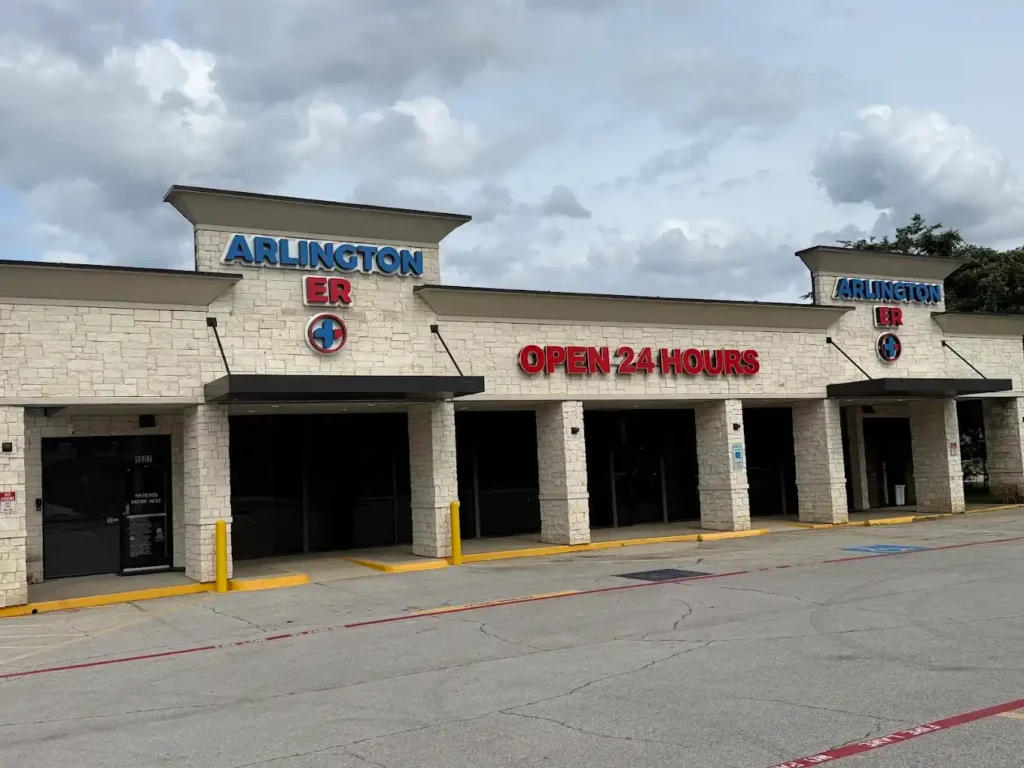
Arlington ER serves Arlington, Texas from 1607 S. Bowen Rd., on the west side of Bowen just south of Pioneer Parkway. Parking is directly outside the entrance and restrooms are immediately inside, which is not a small thing with this illness.
We are minutes from central Arlington and the Parks Mall, and a short drive from Dalworthington Gardens, Kennedale, Grand Prairie, and Mansfield. From I-20, exit at Bowen Road and head north. From Highway 303 or Pioneer Parkway, turn south onto Bowen and we are on your right. Our Contact Us page has anything else you need.
We are open every hour of every day, holidays included, with no appointment or referral required.
If hours have passed with nothing staying down, if there is blood, or if a child has stopped drinking, walk in. We can settle the vomiting and replace what you have lost far faster than waiting it out will.
Most cases settle within one to three days, with the worst of it in the first twelve hours. Anything still going strongly past two days deserves assessment rather than more waiting.
Often not. Depending on the cause, symptoms can begin anywhere from thirty minutes to a week after eating, so the meal people blame is frequently the wrong one.
Some causes spread person to person very easily, others not at all. Assume it is contagious: wash hands thoroughly and avoid preparing food for anyone else until symptoms have been gone a couple of days.
Once vomiting has stopped for several hours, start with small amounts of bland food. There is no need to starve yourself, and eating gently helps the gut lining recover faster than fasting does.
If several people were affected by the same meal, yes, it is worth reporting to your local health department. That is genuinely how outbreaks get identified and stopped.
Only when it changes something. Most people recover before results return, so testing is reserved for blood in the stool, a high fever, a prolonged illness, or a higher-risk patient.
Most people notice a real difference within twenty to thirty minutes, particularly once the vomiting has been settled. A typical visit runs one to three hours.
Yes, and it happens regularly after a shared meal. Each person is registered and assessed individually, which also means each is billed as a separate visit.
Medically reviewed by Rahman Mohammed, MD | Last Updated: September 23, 2026