
An on-site laboratory running around the clock, with the results that change a decision back in minutes rather than days. That speed is the entire reason an emergency room has its own lab.
Blood work, urine testing, and rapid infection tests, all interpreted here by the physician who examined you and explained before you leave.
Everything needed to answer an emergency question tonight. The point of an on-site lab is not that it runs more tests than anywhere else, it is that the results arrive while they can still change what happens to you.
These are the ones that most often decide a visit.
What an ER lab does not do is routine screening. Cholesterol checks, annual bloods, hormone panels and allergy testing all belong with your own physician, where they are cheaper and where someone will follow the results over time.


Most within thirty to sixty minutes, and some within a few minutes. A small number genuinely take days, and knowing which is which explains a great deal about how a visit unfolds.
Minutes. Molecular strep and respiratory testing, blood sugar, urine dipstick and pregnancy testing are all run here, meaning the result appears at the bedside rather than traveling anywhere.
Thirty to sixty minutes. Blood counts, kidney function, liver function and cardiac markers. This is the bulk of emergency testing and it is why a visit involving blood work rarely takes under two hours.
Days. Cultures, where a sample is grown to identify an organism and find what it responds to. Growing takes the time it takes and no laboratory can shorten it.
That last group is why a result can arrive after you have gone home, and occasionally why we call you back. It is not that something was overlooked, it is that the biology finished after you did. Make sure we have a phone number you actually answer.
Less than most people hear. A normal result rules out the specific things that test was looking for, at the moment the sample was taken. It is not a clean bill of health, and it is worth understanding why.
Timing is the biggest limitation. Cardiac markers rise over hours, so a normal result taken forty minutes after chest pain started can be genuinely normal while a heart attack is under way. That is precisely why a second sample is taken later rather than sending you home on the first one.
Sensitivity is the second. No test catches everything it looks for. A normal white cell count does not exclude infection, and plenty of seriously ill people have entirely unremarkable blood counts. This is why results are read alongside how you look, not instead of it.
Scope is the third and the most misunderstood. Blood work only answers the questions it was asked. It does not screen for cancer, it does not exclude a clot on its own, and it says nothing at all about most conditions. Being told your bloods are normal means the specific dangerous causes considered tonight were not found.
None of this makes a normal result worthless. It is frequently the whole point of the visit, and excluding a heart attack or a serious infection is a real and valuable answer. It simply is not the same as nothing being wrong, and if symptoms continue or worsen after you leave, come back rather than assuming it was already ruled out.
No preparation is needed and you do not need to fast. A few things do change how we take the sample or how we read it.
| Tell us or do this | Avoid this |
|---|---|
| Say if you are on blood-thinning treatment | Assuming it only matters for surgery |
| Mention if you faint or feel faint with needles | Staying quiet and standing up afterward |
| Point out an arm with a shunt or past surgery | Letting us use an arm that should be avoided |
| Drink water while waiting, unless told not to | Arriving dehydrated, which makes veins hard to find |
| Say if bloods were taken elsewhere in the last day | Repeating tests done hours ago somewhere else |
| Give a phone number you will actually answer | Leaving a number you never pick up |
The fainting row is not a small thing. A significant number of people feel lightheaded during a blood draw, and it is far easier to lie you down beforehand than to catch you afterward. Nobody will think less of you, and saying so takes two seconds.
The last row matters more than it looks. Culture results arrive days later, and if one shows something that needs treating we have to be able to reach you. A number you do not answer is the most common reason an important result sits unactioned.
Tests are chosen to answer a specific question, drawn once wherever possible, run here, and explained to you rather than handed over as a page of numbers.
Tests follow a question raised by your history and examination, rather than a fixed panel run on everyone.
Several tests come from the same draw wherever possible, and the line placed for bloods can also give fluids.
Samples go a few steps to our own laboratory rather than into a courier van and out of the building.
Pain relief, fluids and urgent treatment start while results are pending. Nobody waits in discomfort for a number.
What each result means for you, including which were normal and what that does and does not exclude.
Cultures that finish after you leave are reviewed, and you are contacted if anything needs acting on.
Because we cannot see you again next week. That single constraint explains almost every difference between emergency testing and clinic testing, and it is worth stating plainly rather than leaving people to assume the worst.
Your own physician can reasonably say let us try this and review you in a two weeks. Time is a diagnostic tool they can use safely, because they know your history and they will see you again.
An emergency room has one encounter. We are meeting you for the first time, often at three in the morning, and the question is not what is most likely but what could kill you tonight. Those are different questions and they produce different tests.
So the dangerous possibilities get excluded before the likely one gets confirmed. A young person with chest pain almost certainly has something benign, and the testing is aimed at the small chance it is not, because that is the version that cannot wait.
Where this becomes unreasonable is testing without explanation. You are entitled to ask what a test is looking for and what would change if it were skipped, at any point, and to get a straight answer. If a test is being ordered out of habit rather than to answer a question, that is a fair thing to challenge.
Samples are processed here rather than couriered elsewhere, which is what turns days into minutes.
Before it is taken, not after the bill arrives. Ask at any point and you will get a straight answer.
Smaller volumes, smaller needles, and a team used to making it quick rather than a battle.
On request, so your regular care continues from what we found rather than starting again.
Lab work is billed alongside the emergency visit, per test rather than as a flat fee, which is why two people who both had bloods taken can receive quite different bills.
The most important thing to say is this: you cannot come here just for blood work. An emergency room cannot act as a walk-in lab. If you have a request form from your own physician and no urgent symptoms, an outpatient laboratory is the correct and far cheaper place to go, and we will tell you so at the desk rather than register you.
What we are for is the situation where the result has to arrive tonight to change what happens next: chest pain that needs cardiac markers now, a fever with no obvious source, sudden weakness, or an illness that has become worse rather than better.
Two billing quirks are worth knowing in advance. Cultures sent after you leave can appear as a separate charge days later, which surprises people who thought the visit was closed. And a repeated test is not duplication or an error, because in emergency medicine the change between two samples is frequently the answer, particularly for cardiac markers.
Ask what is being ordered and why, at any stage. It is a reasonable question and it is easier to answer before the tests are run than after.
The federal No Surprises Act protects patients from surprise bills for emergency care. Our Financial Support and Care Relief Program can substantially reduce out-of-pocket costs for those who qualify, and our Billing Disclosure page sets out the detail.
Arlington ER runs the BioFire SpotFire respiratory panel on site. It is a molecular test that checks for up to 15 respiratory infections from a single swab, with results in about 15 minutes. Most clinics still use an older antigen test that checks for one or two infections and misses more cases.
For billing questions: 817-973-7406 or info@arlingtoner.com
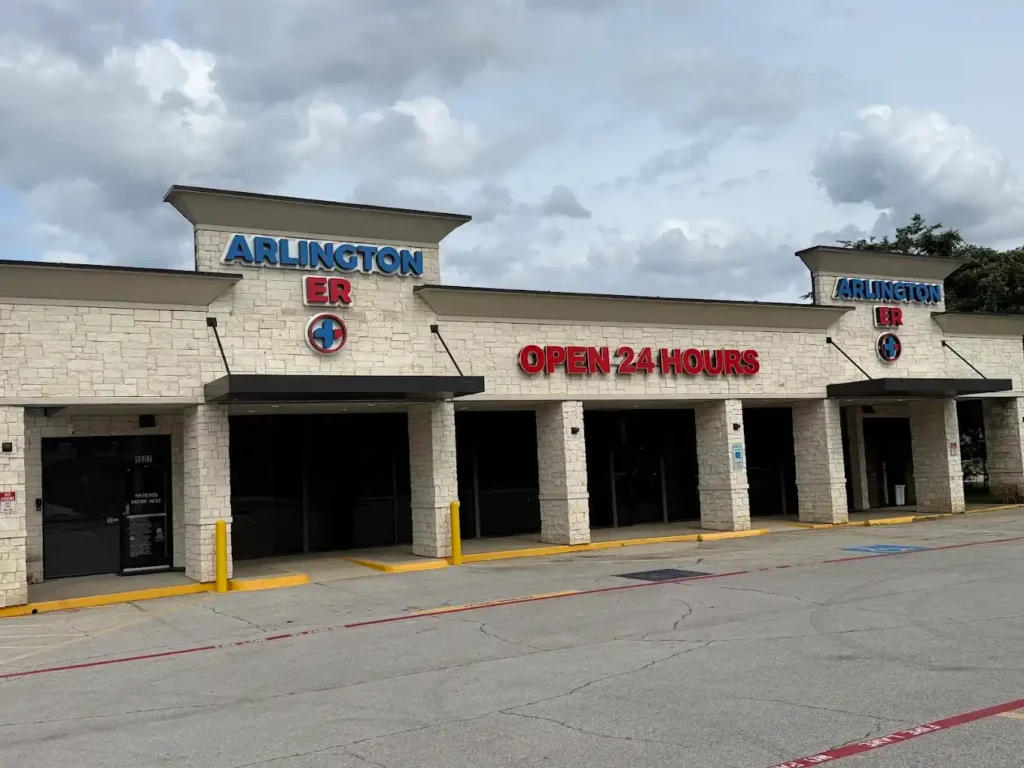
Arlington ER serves Arlington, Texas from 1607 S. Bowen Rd., on the west side of Bowen just south of Pioneer Parkway. Parking is directly outside the entrance.
We are minutes from central Arlington and the Parks Mall, and a short drive from Dalworthington Gardens, Kennedale, Grand Prairie, and Mansfield. From I-20, exit at Bowen Road and head north. From Highway 303 or Pioneer Parkway, turn south onto Bowen and we are on your right. Our Contact Us page has anything else you need.
Please note we cannot run blood work as a standalone service. Lab testing here is part of an emergency assessment. If you have a request form from your physician and no urgent symptoms, an outpatient laboratory is the right and cheaper option. For anything urgent, we are open every hour of every day with no appointment needed.
An on-site laboratory running around the clock, with the results that change a decision back in under an hour. If something is wrong and you need to know now rather than next week, that is what this is for. Open 24/7, no appointment needed.
No. Emergency tests are interpreted knowing you have not fasted, and nobody should delay coming in for that reason. Fasting matters for some routine outpatient tests, not for the ones that answer an emergency question.
No. An emergency room cannot act as a walk-in laboratory, and testing here is part of an emergency assessment. With a request form from your own physician and no urgent symptoms, an outpatient laboratory is the correct and much cheaper route.
Because the change between two samples is often the answer. Cardiac markers rise over hours, so a single normal result early on proves very little. The second draw is deliberate rather than a repeat of a failed one.
Far less than it looks. Several small tubes together come to a few teaspoons, which the body replaces quickly. Children are drawn in smaller volumes still, calculated for their size.
Yes. Ask before you leave and we will arrange it, and we can send them to your own physician on request. Take them to any follow-up appointment, because comparing today’s numbers to later ones is genuinely useful.
Pending results are reviewed after you leave and you will be contacted if anything needs acting on, which is why the phone number we hold matters. Cultures in particular take days, and that delay is biology rather than backlog.
Urine answers questions blood cannot, and quickly. It finds infection, blood, dehydration and pregnancy, and a urinary infection is one of the most common hidden sources of fever, confusion in older adults, and abdominal pain.
Normal results exclude the dangerous causes considered tonight; they do not prove nothing is wrong. Plenty of real conditions produce normal blood work. Follow up with your own physician, and come back if symptoms worsen or change.
Medically reviewed by Rahman Mohammed, MD | Last Updated: September 23, 2026