
A stroke rarely announces itself the way people expect. Sometimes the signs are unmistakable. Just as often the person having one insists they are fine, and the argument in the kitchen costs more than the drive would have.
Our stroke emergency room in Arlington gets a CT scan running within minutes of arrival, read here by a board-certified physician rather than sent somewhere else and waited on. If you are seeing stroke signs in someone right now, call 911 first and read the rest afterwards.
The warning signs of a stroke are a drooping face, an arm that drifts down or will not lift, slurred or scrambled speech, sudden vision loss, and a sudden loss of balance. Any single one of these means call 911 immediately. You do not need the full set.
The memory aid worth keeping is BE FAST: Balance, Eyes, Face, Arms, Speech, Time. The first two were added because loss of balance and sudden vision changes are the signs people most often dismiss, and the last is a reminder that the clock is part of the diagnosis.
One caution worth holding onto. A person in the middle of a stroke often cannot judge their own condition, and the part of the brain affected may be the part that would notice something is wrong. If you can see it and they cannot, trust what you can see.


One type is caused by a blockage that closes off a vessel and starves the brain tissue beyond it. The other is caused by a vessel tearing and bleeding into the brain. They produce identical symptoms from the outside, but they need opposite treatment, which is why imaging comes first.
From the doorway there is no telling them apart: the same drooping face, the same failing arm, the same scrambled speech. No amount of experience lets a physician distinguish them by examination alone, and an approach that helps one can badly worsen the other.
That single fact explains the whole shape of a stroke workup. Nothing meaningful begins until a scan has answered the question, and everything after the scan follows from the answer. It is also why a stroke evaluation starts with imaging rather than with a long conversation about how the symptoms feel.
The blockage type is far more common, accounting for the large majority of strokes. The bleeding type is less common but tends to arrive more dramatically, often with a sudden severe headache, vomiting, or a rapid slide in alertness.
Yes. A mini-stroke is an emergency even though the symptoms have already gone. It means blood flow to part of the brain was interrupted and then restored, and a meaningful share of people who have one go on to have a full stroke within days.
Sometimes the face straightens, the arm comes back, and the speech clears, all within twenty minutes. Everybody exhales and decides the trip is no longer necessary. That decision is the dangerous part.
The name does the condition no favors. It sounds like a smaller problem when it is really an earlier one, and the word mini persuades families to treat a warning as an all-clear. The interruption is the point, not the recovery.
Practically, the window between a warning episode and a larger event is the most useful window anyone gets. It is the one moment when the cause can be found and addressed before damage is done. That is the entire reason to come in on a day when you feel completely fine and can no longer point to anything wrong.

Keep the person still, note the time, and stay with them. The most common mistakes here come from wanting to help, so the second column matters as much as the first.
| Do this | Never do this |
|---|---|
| Call 911 immediately | Drive them yourself to save time |
| Note the last moment they seemed normal | Guess the time later from memory |
| Help them lie down with the head slightly raised | Encourage them to walk it off or stand up |
| Turn them on their side if they vomit | Leave them flat on their back unattended |
| Loosen tight clothing at the neck | Give food, drink, or anything by mouth |
| Stay and keep watching for any change | Wait to see whether it clears on its own |
Nothing by mouth is the rule people find hardest. A stroke can affect swallowing before anyone notices, so a glass of water offered kindly can end up in the lungs. Wait until a physician has checked.
The last moment the person was definitely normal. That single detail shapes every decision that follows, and it is the question families most often cannot answer. Everything else on this list helps, but nothing else comes close.
The last time they were definitely themselves. Not when the symptoms were noticed, but the last moment you are certain nothing was wrong. If someone woke up this way, the clock starts when they went to bed. Check a phone, a sent message, a television schedule, anything that pins it down to a real time rather than an estimate.
What you saw first, and what came next. Symptoms that arrived all at once suggest something different from symptoms that built over an hour.
Whether anything like this has happened before. A brief episode last month is directly relevant, even if it passed in minutes and nobody mentioned it again.
Their medical history, in plain terms. High blood pressure, diabetes, an irregular heartbeat, or a previous stroke all change how borderline findings are weighed.
Any recent head injury, fall, or surgery. This matters a great deal for what is safe to do next, so please mention it even if it seems unconnected.
If you were not there when it started, say so plainly rather than guessing. An honest window of uncertainty is far more useful to the physician than a confident time that turns out to be wrong.
Your physician fixes the time symptoms began, runs a structured neurological exam, gets a CT scan without delay to separate a blockage from a bleed, adds bloodwork and a heart tracing, and coordinates transfer to a stroke unit once you are stable. These steps run alongside each other rather than in sequence.
We fix the last known well time before anything else, because it defines which options remain open.
A structured assessment of speech, strength, sensation, vision, and balance, scored so any change is obvious.
Imaging separates a blockage from a bleed. Our scanner is on site, so nobody waits on a transfer for this.
Lab results and an EKG rule out conditions that mimic stroke and flag rhythm problems that can cause one.
Blood pressure, rhythm, oxygen, and neurological status are watched without pause, since stroke can change quickly.
A confirmed stroke needs a specialist stroke unit. We stabilize and hand over to a team already expecting you.
Nothing that could worsen a bleed happens before a scan has ruled one out. The order is not negotiable.
Low blood sugar, seizures, and severe migraine can all imitate a stroke closely. Each has a different answer.
A warning episode earns the same investigation as an active stroke, because it is a forecast rather than an all-clear.
Stroke recovery belongs in a dedicated unit. We diagnose, stabilize, and coordinate the handover directly.
A stroke evaluation is billed as an emergency visit plus the imaging and laboratory work your physician orders. We bill most major private insurance plans and file the claim for you. Arlington ER is out-of-network for all private plans, but under the federal No Surprises Act an emergency visit is still processed at your in-network cost-sharing, so what you owe depends on your own deductible and coinsurance rather than a fixed figure anyone could quote at the door.
Stroke raises one billing question that other emergencies do not, and it is worth understanding before it happens. If your scan confirms a stroke, ongoing care belongs in a hospital stroke unit, which means an ambulance transfer. That transfer is billed separately by the ambulance service, not by us, and the receiving hospital bills its own admission separately again. Families are sometimes surprised to receive three sets of paperwork for what felt like one continuous event. Nothing has gone wrong when that happens.
The federal No Surprises Act protects patients from surprise bills for emergency care, so nobody should be checking network status while someone is having a stroke. Our Patient Billing Advocates will sit down with the paperwork afterwards and work through what belongs to whom, and our Financial Support and Care Relief Program can reduce or remove out-of-pocket costs for patients who qualify. Your full rights are set out on our Billing Disclosure page.
Nobody is asked about payment before being evaluated. With a stroke, the cost of hesitating is measured in something insurance cannot reimburse.
Low blood sugar, a seizure and the confusion that follows one, a severe migraine with aura, an inner ear disturbance, and occasionally a serious infection in an older adult can all produce symptoms that look convincingly like a stroke.
We mention this for one reason only: so that nobody talks themselves out of coming in on the grounds that it is probably just a migraine. Those alternatives are real, several of them are common, and a good number of people who arrive with stroke symptoms turn out to have one of them instead. That is a genuinely good outcome, and it is not a wasted trip.
What it is not is something to diagnose from your kitchen. The conditions on that list need ruling out by examination and imaging, not by reasoning from how the symptoms feel. If a migraine sufferer develops weakness down one side for the first time, that is a stroke workup, not a migraine.
Come in. Being told it was a migraine after a scan is a far better afternoon than being told it was a stroke after a delay.
For billing questions: 817-973-7406 or info@arlingtoner.com
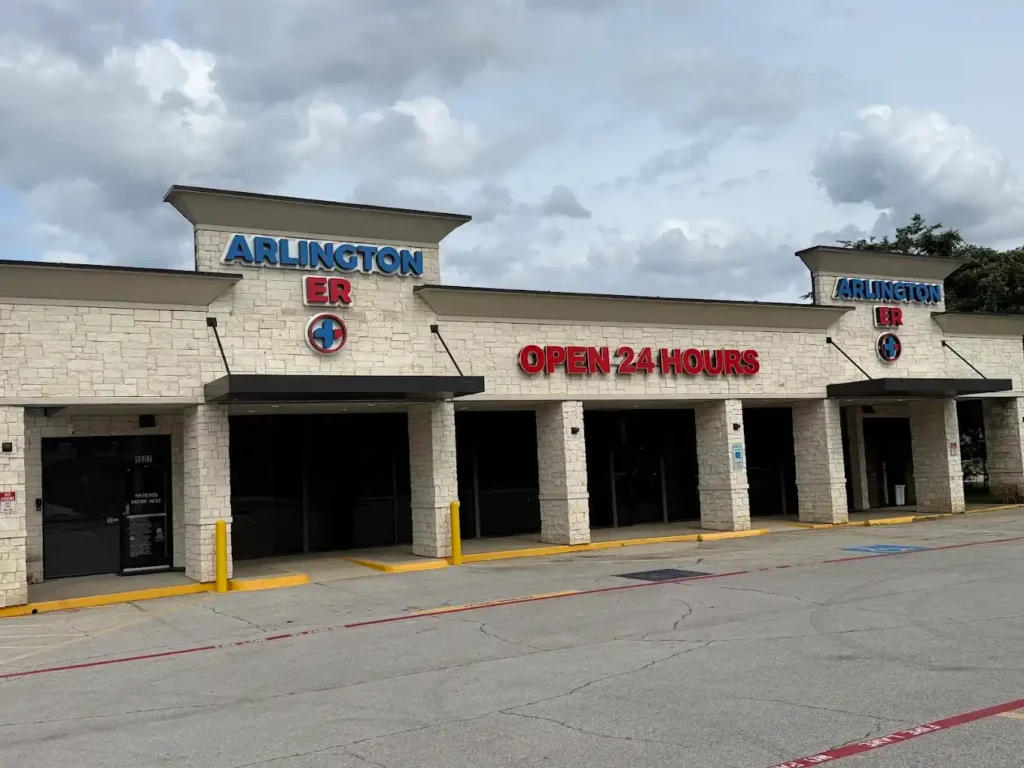
Arlington ER serves Arlington, Texas from 1607 S. Bowen Rd., on the west side of Bowen just south of Pioneer Parkway. Parking is directly outside the entrance, which matters more than it sounds when someone cannot walk steadily.
We are minutes from central Arlington and the Parks Mall, and a straightforward run from Dalworthington Gardens, Kennedale, Grand Prairie, and Mansfield. From I-20, exit at Bowen Road and head north. From Highway 303 or Pioneer Parkway, turn south onto Bowen and we are on your right. If you would rather speak to someone first, everything you need is on our Contact Us page.
For an active stroke, please call 911 rather than driving. We are open every hour of every day, holidays included, and no appointment or referral is ever required.
Brain tissue does not wait for anyone to feel certain. If you are seeing stroke signs, call 911 now. If symptoms have already faded and you are wondering whether it still counts, it does, and we would rather see you today than next week.
Immediately. Certain stroke treatments only remain available for a limited number of hours after symptoms begin, and the sooner someone is assessed, the more options stay open to them.
Yes. Stroke is more common with age, but it happens to younger adults too, and being young often delays the decision to seek help. Age on its own rules nothing out.
The scan and first assessment happen within minutes of arrival. How long you stay afterwards depends on what is found, since a confirmed stroke moves quickly toward transfer.
Call 911 for active symptoms. If the episode has fully resolved and the person is back to normal, driving in is reasonable, though an ambulance is always the safer choice.
Yes, and we encourage it. Whoever witnessed the onset holds information the patient cannot supply, and their account often shapes the evaluation more than anything else available.
A photo ID and insurance card if they are within reach, plus the name of their regular doctor. Never delay leaving to find paperwork. Everything else can be sorted out here.
Yes. Tell us their usual baseline on arrival, because what counts as a change is different for every patient. A relative’s account of normal is exactly what we need.
Yes. Ask at discharge and we will send records to your primary care physician or neurologist, and hand you a copy so the follow-up never depends on paperwork arriving somewhere.
Medically reviewed by Rahman Mohammed, MD | Last Updated: August 22, 2026