
Appendicitis almost never announces itself clearly. It usually starts as a vague ache around the navel that nobody takes seriously, and only hours later settles into the lower right side and starts to feel like something.
That drift is the tell, and it is why so many people arrive later than they should. Our appendicitis emergency room in Arlington runs CT imaging and laboratory testing on site, so the question gets answered in hours rather than being watched overnight at home.
The symptoms of appendicitis are pain that begins near the navel and shifts to the lower right side, loss of appetite, nausea, a low fever, and pain that worsens with movement, coughing, or going over a speed bump. The shift in location is the most useful sign of all.
Loss of appetite deserves particular attention. It is one of the earliest and most consistent signs, and it is the one families most often overlook. Someone with appendicitis usually does not want food, and a person who is genuinely hungry is less likely to have it.
The order matters as much as the list. In appendicitis the pain almost always comes first and the nausea follows. When vomiting arrives first and pain second, a stomach bug is more likely.


Appendicitis pain classically begins around the navel and then settles into the lower right side of the abdomen, roughly a third of the way along a line from the hip bone to the belly button. That migration usually happens over six to twenty-four hours.
The reason for the move is worth knowing, because it explains why the early hours are so easy to dismiss. At first the body registers only a vague, poorly located ache, the same way it reports most internal discomfort. Once the inflammation reaches the lining of the abdominal wall, the brain suddenly gets a precise address, and the pain becomes sharp and specific.
That is why a stomach ache that started nowhere in particular and has now picked a spot is worth taking seriously, even if it is not yet severe. The sharpening is the progress, not the severity.
Not everyone follows the script. The appendix does not sit in the same place in every person, so the pain can appear lower, further back, or higher up. In pregnancy it often sits higher still. An unusual location does not rule appendicitis out.
Appendicitis can progress to rupture within roughly a day or two of symptoms starting, and sometimes faster. There is no way to predict which case will move quickly, which is exactly why it is assessed the same day rather than watched at home.
Once the appendix ruptures, the problem changes character entirely. What was a contained inflammation becomes a spreading infection inside the abdomen, and recovery goes from a short procedure and a few days to something considerably longer and more difficult.
There is one detail here that misleads people badly, so it is worth stating plainly. At the moment of rupture the pain often eases, because the pressure inside the appendix has been released. People take that relief as a sign of improvement and go back to bed. Within a few hours the pain returns, worse and spread across the whole abdomen. Sudden relief after severe pain is a reason to come in immediately, not a reason to relax.
The practical rule is simple. Suspected appendicitis is a today problem. Waiting to see how the night goes is the decision that turns a straightforward case into a complicated one.

Some of the most common home remedies actively make appendicitis harder to diagnose or more dangerous. The right-hand column is not a list of minor mistakes.
| Do this | Never do this |
|---|---|
| Note when the pain started and where | Wait overnight to see how it develops |
| Stop eating and drinking once pain is significant | Eat a meal in case surgery is needed later |
| Rest still and let someone else drive | Apply a heating pad to the painful area |
| Note any fever and keep checking it | Use a laxative or an enema to clear it |
| Come in the same day, not tomorrow | Treat sudden relief as a sign of recovery |
| Tell us the exact order symptoms appeared | Assume it must be a stomach bug |
Two of those need explaining. Heat on an inflamed appendix can encourage it to rupture, which is why a heating pad is genuinely unsafe here rather than merely unhelpful. And anything that stimulates the bowel carries the same risk, so the instinct to clear things out is one to resist entirely.
The eating advice is practical rather than medical. If an operation turns out to be needed, an empty stomach makes anesthesia safer, and a meal eaten an hour before arriving can delay things.
Your physician examines the abdomen carefully, runs bloodwork for signs of infection, uses CT or ultrasound to look at the appendix directly, works to keep you comfortable, and coordinates a surgical consultation without delay if the scan confirms it.
How the abdomen responds to pressure, and to its release, tells a physician a great deal before any test is run.
A raised white cell count supports the picture. Our laboratory returns results here in minutes, not hours.
CT shows the appendix directly and settles the question. Ultrasound is often used first for children and in pregnancy.
Fluids through a vein while you cannot eat or drink, and work to ease the pain while the picture is established.
If imaging confirms appendicitis, a surgeon is brought immediately rather than in the morning.
Appendicitis needs an operating room. We stabilize, coordinate, and hand over to a team already expecting you.
A stomach bug, a kidney stone, ovarian conditions, a urinary infection, inflammatory bowel conditions, and in women an ectopic pregnancy can all produce lower right abdominal pain that resembles appendicitis closely.
This is precisely why the diagnosis is not made from symptoms alone. Several of those alternatives are common, several need urgent treatment of their own, and one of them is a genuine emergency in its own right. Imaging and testing are what separate them.
A kidney stone is the most frequent mimic we see, and it usually gives itself away by sending pain toward the groin and by making people restless rather than still. Someone with appendicitis tends to lie very still, because movement hurts.
For women of reproductive age, the assessment always includes ruling out causes involving the ovaries and early pregnancy. That is standard practice rather than a comment on anyone’s circumstances, and it exists because those conditions can be serious and are easily mistaken for appendicitis.
Being told it was not your appendix, after a scan has proved it, is a good outcome. Deciding at home that it is probably just a bug is where things go wrong.
CT and ultrasound are here and staffed at every hour, so nobody is sent home to see how the night goes.
For children and in pregnancy we start with ultrasound where it can answer the question without radiation.
A normal appendix does not end the visit. We keep going until we can tell you what is actually causing the pain.
A confirmed appendicitis moves straight to a surgical consultation and transfer. Nothing waits for business hours.
Yes, and in both groups it is harder to spot and more likely to be found late. Children often cannot describe where the pain is, and older adults frequently have milder symptoms that do not look alarming enough to act on.
In young children the picture can be nothing more than a child who has gone quiet, will not eat, and does not want to be picked up. There may be no clear pointing to the lower right at all. Refusing to walk, or walking bent over, is often the most useful sign a parent can report. Our pediatric emergency room assesses this frequently, and we would always rather check than have a family talk themselves out of coming.
In older adults the fever may be absent, the white cell count unremarkable, and the pain modest even when the appendix is badly inflamed. The body simply mounts a quieter response with age. That is why a persistent abdominal pain in an older adult deserves the same scan as a dramatic one in a twenty-year-old.
Pregnancy adds its own complication, since the appendix shifts upward as pregnancy advances and the pain appears in an unexpected place. Ultrasound is used first here for good reason.
The emergency visit is billed as an emergency visit plus the imaging and laboratory work your physician orders. We bill most major private insurance plans and file the claim for you. Arlington ER is out-of-network for all private plans, but under the federal No Surprises Act an emergency visit is still processed at your in-network cost-sharing, so your share depends on your own deductible and coinsurance.
Appendicitis carries a billing structure worth understanding before it happens, because it involves more parties than most emergencies. Our bill covers the diagnosis: the visit, the scan, the bloodwork, and the physician who put it together. The operation itself is performed at a hospital by a surgeon, and both of those bill you separately, as does the anesthesia team. Families frequently receive four sets of paperwork for what felt like a single event. Nothing has gone wrong when that happens.
The part worth weighing is what the diagnosis buys. An appendix removed before it ruptures means a shorter operation and a quicker recovery. An appendix that ruptures overnight means a longer hospital stay and a considerably larger total bill. Coming in early is very often the cheaper path as well as the safer one.
The federal No Surprises Act protects patients from surprise bills for emergency care. Our Patient Billing Advocates will work through every statement with you, and our Financial Support and Care Relief Program can reduce or remove out-of-pocket costs for those who qualify. See our Billing Disclosure page for details.
For billing questions: 817-973-7406 or info@arlingtoner.com
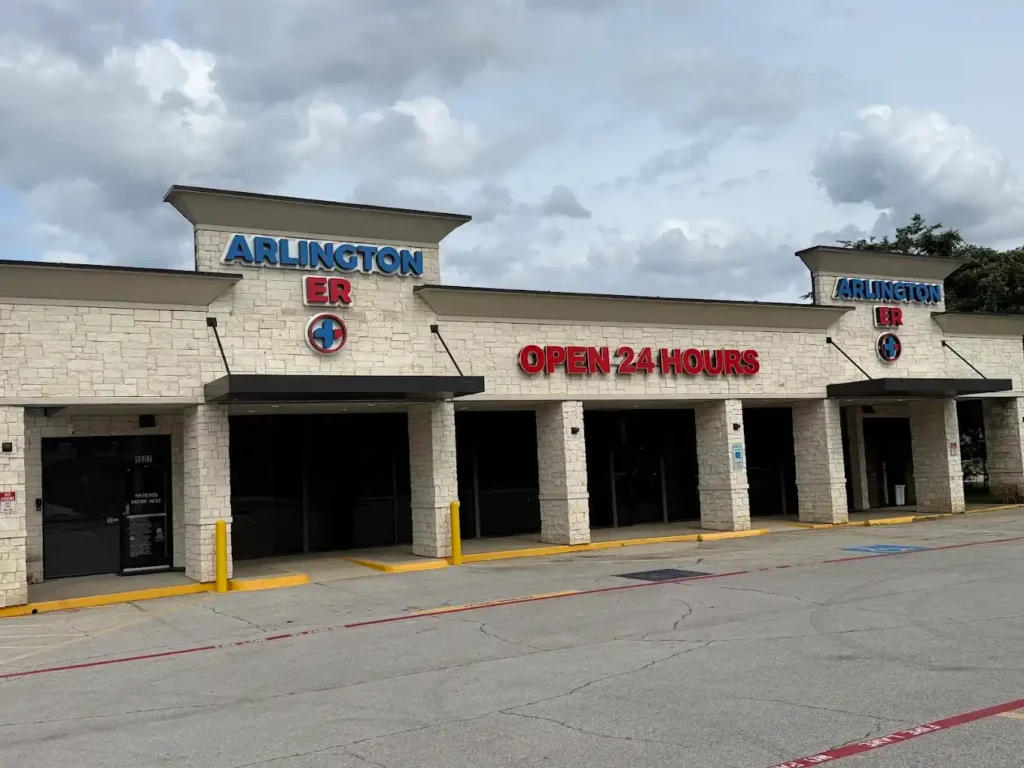
Arlington ER serves Arlington, Texas from 1607 S. Bowen Rd., on the west side of Bowen just south of Pioneer Parkway. Parking sits directly outside the entrance, which matters when every step and every bump hurts.
We are minutes from central Arlington and the Parks Mall, and a short drive from Dalworthington Gardens, Kennedale, Grand Prairie, and Mansfield. From I-20, exit at Bowen Road and head north. From Highway 303 or Pioneer Parkway, turn south onto Bowen and we are on your right. Our Contact Us page has anything else you need.
Please have someone drive you rather than driving yourself. We are open every hour of every day, holidays included, with no appointment or referral required.
If a stomach ache has moved to the lower right and you have lost your appetite, that is worth checking today rather than sleeping on. A scan that rules it out is a good evening. A rupture overnight is not.
Usually within a couple of hours of arriving. The examination and bloodwork happen quickly, and the scan settles the question. You will not be sent home to see how it goes overnight.
If the scan confirms appendicitis, an operation is usually arranged the same day. The surgeon makes that call and will discuss the timing and approach with you directly.
Not reliably, and it is not something to gamble on. Some very mild cases settle, but there is no way to identify those in advance, and the alternative outcome is a rupture.
No. We diagnose, stabilise, and coordinate the surgical consultation and transfer. The operation takes place at a hospital with a surgical team already expecting you.
Better not to, once the pain is significant. An empty stomach makes anaesthesia safer if an operation is needed, so avoiding food and drink can prevent a delay later.
A photo ID and insurance card if they are to hand, plus a note of when the pain started and how it moved. Do not delay coming in to find paperwork.
Yes. Records and imaging go to your primary care physician or the receiving surgical team, and you can have a copy to take with you. Just ask at discharge.
Alongside Arlington, we regularly treat patients from Dalworthington Gardens, Kennedale, Grand Prairie, and Mansfield. Our S. Bowen Rd. address is postally Pantego, a small town enclosed within Arlington itself.
Medically reviewed by Rahman Mohammed, MD | Last Updated: September 23, 2026