
Chest pain puts you in an impossible position. Brush it off and you could be gambling with your heart. Come in and you risk feeling foolish when it turns out to be something you ate. Most people spend the worst part of that hour arguing with themselves instead of finding out.
Our chest pain emergency room in Arlington settles the question with a 12-lead EKG in the first few minutes, backed by cardiac enzyme testing and imaging in the same building. If your symptoms are severe, call 911 rather than driving.
Go to the ER for chest pain when it feels like pressure, squeezing, or heaviness rather than a sharp stab, when it spreads into the jaw, arm, or back, when it comes with breathlessness, a cold sweat, or nausea, or when it lasts more than a few minutes. Any one of those means call 911 now.
Severity on its own is a poor guide. A cardiac event can feel like mild pressure someone talks themselves into ignoring, while a strained muscle between the ribs can feel sharp enough to stop you walking. What matters more is the character of the discomfort, where it travels, and what arrives alongside it.
The pattern below is what changes the answer from wait and see to go now.
Call 911 rather than driving. Paramedics carry a 12-lead EKG and can run it in your driveway, transmit the tracing ahead so the receiving team is already preparing, and correct a dangerous rhythm on the way. A passenger seat can do none of that.

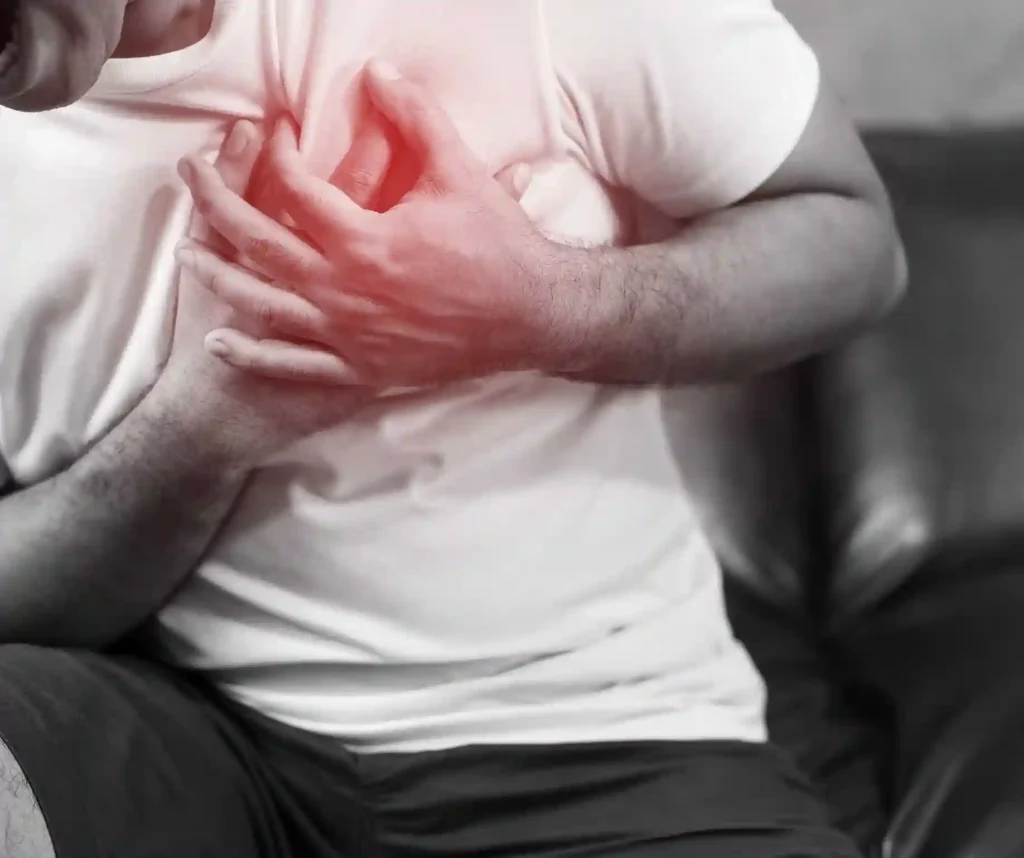
Most chest pain is not a heart attack. Acid reflux, a strained muscle between the ribs, inflammation of the chest wall cartilage, a lung problem such as a clot or a collapsed lung, gallbladder trouble, and panic episodes account for a large share of what comes through the door.
That is genuinely reassuring, and it is also exactly why the visit matters. Reflux can burn in a way that feels convincingly cardiac. A pulled muscle can feel sharp and frightening. Meanwhile a real cardiac event can present as pressure so mild that people talk themselves into bed. The sensation itself is a poor witness.
Two of those non-cardiac causes deserve naming, because people underestimate them badly. A clot in the lung can produce sudden breathlessness with sharp pain that worsens on breathing in, and it is every bit as urgent as a cardiac event. A tear in the wall of the main artery leaving the heart can feel like something ripping through to the back. Neither is common. Both are why a proper workup looks past the heart as well as at it.
Whatever is causing it, you deserve to leave knowing the name of it. A non-cardiac answer is still an answer, and it is a far better thing to carry home than a shrug.
Women more often experience a cardiac event without the crushing central chest pain most people expect. It can arrive instead as breathlessness, unusual fatigue, nausea, jaw or back ache, or discomfort between the shoulder blades. The same quieter pattern is common in older adults and in people living with diabetes.
Part of the reason is anatomical. Smaller vessels can be involved rather than one large blocked artery, which produces a more diffuse discomfort than a single crushing point. In diabetes, years of altered nerve signaling can blunt the warning entirely, so the heart sends a weaker message than the situation warrants.
The consequence is the part worth acting on. People with these quieter presentations wait longer before seeking help, and are more often told it is something else on the first try. If your symptom does not resemble the version from the movies, that is not evidence in your favor. It is the reason to have it checked.

Stop moving, sit somewhere you can be seen, and unlock the front door. The list below is worth reading before you ever need it, because nobody thinks clearly in the middle of it.
| Do this | Never do this |
|---|---|
| Call 911 and stay on the line | Drive yourself, or let a relative drive you |
| Sit down and stop all exertion immediately | Walk it off, or finish what you were doing |
| Unlock the door so paramedics can reach you | Lock yourself in a bathroom or upstairs room |
| Note the exact time the discomfort started | Guess later, or round it to the nearest hour |
| Stay with the person and keep them still | Leave them alone to rest and check back |
| Come in even if the pain eases on the way | Turn around because it seems to have passed |
That last row catches people out constantly. Cardiac pain can ease and then return worse, and the quiet stretch in between is exactly when families decide to go home. Get the tracing anyway.
Tell us when the discomfort started, what you were doing at the time, whether it has happened before, what else you are feeling, and whether heart disease runs in your family. Those five details shape the evaluation more than anything else, and they are easy to lose once adrenaline takes over.
When it started, and how quickly it built. Pain that arrived over seconds tells a different story than pain that crept up across an afternoon.
What you were doing at the time. Discomfort that appears during exertion and settles with rest follows a recognizable pattern. Discomfort that arrives while you are sitting still is a different pattern, and it matters.
Whether it has happened before, and whether this time is worse. A change in something familiar is often more telling than the symptom itself.
Anything that runs in your family. Early heart disease in a parent or sibling shifts how we weigh borderline findings.
Every symptom, even the ones that feel unrelated. Nausea, sweating, jaw ache, and unusual tiredness are part of the picture, not background noise.
If someone is with you, ask them to hold these details on your behalf. Patients in genuine discomfort routinely forget the timeline, and the timeline is the single most useful thing you bring through the door.
Your physician runs a 12-lead EKG within minutes, draws cardiac enzymes, places you on continuous monitoring, and adds imaging where the picture calls for it. Chest pain moves to the front of the line here, ambulance or front door, no exceptions. These steps overlap rather than waiting, because heart muscle is measured in minutes.
Vitals and a short account of what you feel and when it began. No waiting room queue for chest symptoms.
Run within the first few minutes and read on the spot by a board-certified emergency physician.
Bloodwork looks for the protein released when heart muscle is under strain. Results return here in minutes.
Your rhythm, blood pressure, and oxygen are watched without pause while the workup runs.
Chest X-ray or CT rules out lung and vascular causes that can imitate cardiac pain closely.
Your physician tells you what this is, what it is not, and precisely what happens next.
Everything else depends on that answer, so the EKG and enzyme testing lead rather than follow.
Cardiac markers climb over hours, so a repeat draw often reveals what a single early result cannot.
Reflux, muscle strain, and chest wall inflammation are common and treatable, and they still deserve a diagnosis.
A confirmed heart attack needs a catheterization lab. We stabilize, coordinate, and hand you over to a team already expecting you.
The visit is billed as an emergency visit plus the tests your physician orders, usually an EKG, cardiac enzymes, and often a chest X-ray. We bill most major private insurance plans and file the claim for you. Arlington ER is out-of-network for all private plans, but under the federal No Surprises Act an emergency visit is still processed at your in-network cost-sharing, so what you pay depends on your own deductible and coinsurance rather than a single sticker price. We accept most major private plans and file the claim on your behalf.
Chest pain is worth understanding separately from other visits on one point. The workup frequently involves a second enzyme draw a few hours after the first, because those markers climb over time. That repeat test appears on the bill as its own line, and patients who were not expecting it sometimes read it as duplicate billing. It is not. It is the test that catches what an early sample missed, and skipping it is how a real cardiac event gets sent home.
If cost is weighing on the decision to come in, please come in anyway and talk to us afterwards. Federal protections under the No Surprises Act cover emergency care, our Patient Billing Advocates will walk through your Explanation of Benefits line by line, and our Financial Support and Care Relief Program can reduce or remove out-of-pocket costs for patients who qualify. Full details of your billing rights are set out on our Billing Disclosure page.
Nobody at Arlington ER is asked about payment before they are evaluated. Chest pain is exactly the wrong thing to gamble on to save money, and a non-cardiac answer that costs you a copay is still cheaper than the alternative.
Chest pain belongs in an emergency room, not urgent care. Urgent care clinics do not carry cardiac enzyme testing or continuous monitoring, and cannot act on a positive result. Most will send you straight on to an ER, which costs you the one thing a cardiac event does not give back: time.
There is a narrower question worth answering honestly, though, because not every ache in the chest is an emergency. Discomfort that is clearly reproduced by pressing on one spot, that follows an obvious muscle strain, or that has been unchanged for months and is already being managed by your own doctor may reasonably belong with your primary care physician.
Heartburn you have had for years and recognize instantly, soreness after a heavy session at the gym, or a sharp catch that only appears when you twist a certain way are worth mentioning at your next appointment rather than at two in the morning.
Here is where that guidance stops. If anything about it is new, if it is worse than your usual version, if it comes with breathlessness, sweating, or nausea, or if you simply cannot settle because part of you is not convinced, come in. Uncertainty is a legitimate reason to be seen, and nobody here will make you feel foolish for arriving with a strained muscle. We would far rather tell you that than miss the other thing.
For billing questions: 817-973-7406 or info@arlingtoner.com
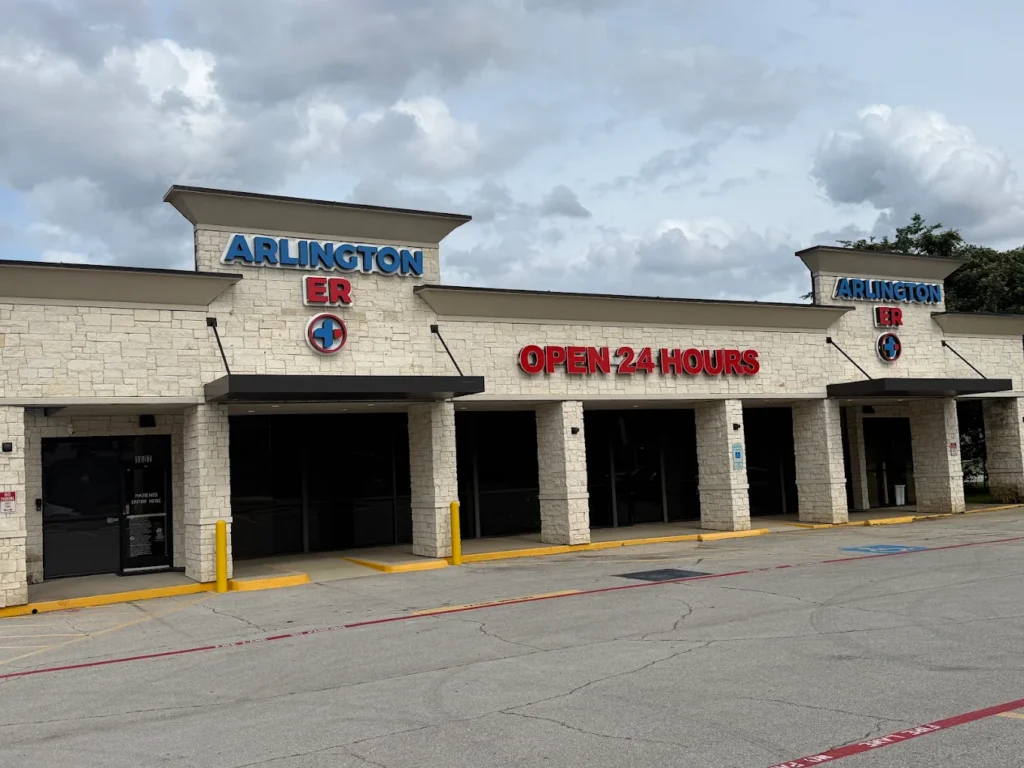
Arlington ER serves Arlington, Texas from 1607 S. Bowen Rd., on the west side of Bowen just south of Pioneer Parkway. Parking sits directly outside the entrance, so there is no garage to navigate and no walk across a hospital campus at the worst possible moment.
We are a few minutes from central Arlington and the Parks Mall, and an easy run from Dalworthington Gardens, Kennedale, Grand Prairie, and Mansfield. Coming from I-20, exit at Bowen Road and head north. Coming from Highway 303 or Pioneer Parkway, turn south onto Bowen and we are on your right. If you would rather speak to someone before setting off, our Contact Us page has everything you need.
We are open every hour of every day, holidays included, and no appointment or referral is ever required.
Every hour of hesitation costs something that does not grow back. If your symptoms are severe, call 911. If they are milder but you cannot let go of them, walk in and let us run the tests that end the argument.
The first tracing and bloodwork happen within minutes of arrival. If your physician wants a repeat enzyme draw to watch the trend, expect to be with us for a few hours rather than a few minutes.
Cardiac markers rise gradually, so an early sample can look normal during a real event. A second draw shows whether the level is climbing, which is often the finding that changes the diagnosis.
Neither. Arlington ER is walk-in only, open every hour of every day including holidays. Arrive whenever you need to, without calling ahead and without a referral from another doctor.
Yes. A family member or friend is welcome to stay with you throughout, and we encourage it. A witness who saw what happened is genuinely useful to the physician assessing you.
A photo ID and your insurance card if you have them to hand. If you do not, come in anyway. We never delay an evaluation over paperwork, and the details can be sorted out afterwards.
Yes. Ask at discharge and we will send your records to your primary care physician or cardiologist, and give you a copy to take with you so nothing depends on the handover.
Yes. Cardiac events in younger adults are less common but not rare, and the tests take minutes. Age alone is not a reason to wait it out, particularly if heart disease runs in your family.
Both, in practice. Our postal address is Pantego, a small town enclaved entirely within Arlington, and we sit on S. Bowen Rd. a few minutes from central Arlington. Most of our patients are Arlington residents.
Medically reviewed by Rahman Mohammed, MD | Last Updated: August 26, 2026