A CT scan with contrast and one without use the same scanner and take about the same amount of time. The difference is a liquid that makes certain things visible which would otherwise blend into everything around them. Whether you need it depends entirely on the question your physician is trying to answer.
Contrast isn’t an upgrade, and going without it isn’t a shortcut. For some questions it’s the only way to get an answer. For others it would actively make the scan worse.
What Is Contrast Dye, and What Does It Do?
A CT builds its picture from differences in density. Bone is dense and shows up bright. Air isn’t and shows up dark. The trouble is that blood, most organs and most soft tissue sit close together on that scale, so a blood vessel and the muscle beside it can look nearly identical.
Contrast is an iodine-based liquid that blocks X-rays far more than tissue does. Put it into the bloodstream and every vessel it reaches lights up. Anything with a heavy blood supply, like an inflamed appendix or an abscess, lights up with it. Anything with a poor blood supply stays dark, which is just as informative.
So contrast doesn’t add detail to the whole image. It separates structures that would otherwise be indistinguishable, which is a different and more useful thing.
When a CT Scan Needs Contrast
Contrast goes in whenever the question involves blood flow, inflammation, or telling one soft tissue from another.
- Suspected blood clot in the lungs
- Appendicitis and most causes of severe abdominal pain
- Abscesses and deep infections
- Tears or bleeding in a major blood vessel
- Injury to the liver, spleen or kidneys after an accident
- Most cancer staging and follow-up
In each of those, the finding is defined by blood supply. Without contrast, the scan would show that the anatomy is there without showing whether anything is wrong with it.
When a CT Scan Is Done Without Contrast
There are scans where contrast would obscure the finding rather than reveal it, and this is the part people rarely hear explained.
Kidney stones are the clearest example. Stones are dense and show up bright on their own. Contrast is also dense, and it drains through the exact same collecting system a stone sits in, so it can hide the thing you’re looking for. A stone protocol CT is deliberately done without it, and we go through that scan in more detail in our piece on kidney stones.
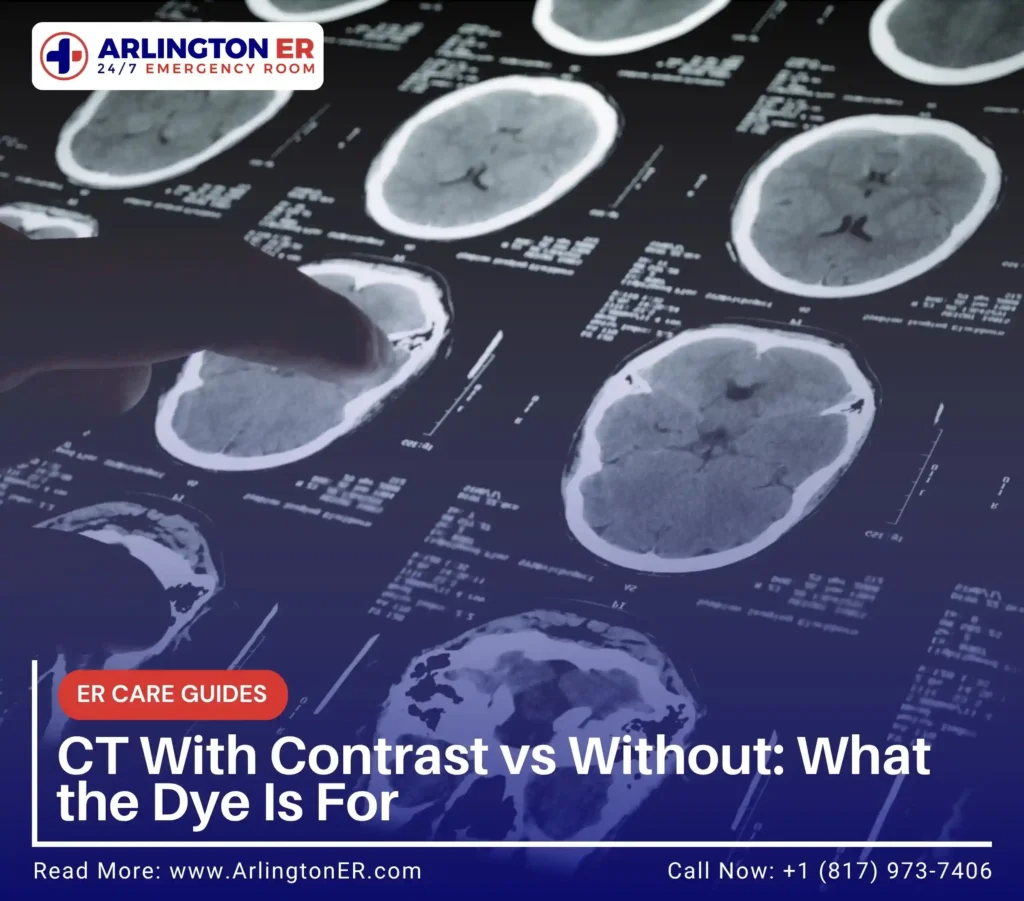
A head CT after an injury is another. Fresh bleeding already appears bright against brain tissue, so no contrast is needed to find it. Adding it would slow the scan down for no benefit, and speed is the entire point when someone has a head injury.
Bone and lung imaging are usually the same story. If the structure of interest already stands apart on density alone, contrast has nothing to contribute.
IV Contrast vs Oral Contrast
There are two ways contrast is given, and some abdominal scans use both.
Intravenous contrast goes in through a line in your arm and reaches your bloodstream within seconds. This is the type that highlights vessels and organs, and it’s what most people mean when they talk about contrast.
Oral contrast is a drink, and it outlines the inside of the digestive tract so the bowel can be told apart from everything packed around it. It takes time to travel, so if you’re asked to drink it there will be a wait before the scan. That wait isn’t a delay in your care; the scan won’t answer the question until the liquid has arrived where it needs to be.
What Contrast Feels Like During the Scan
Intravenous contrast produces a specific and slightly alarming set of sensations, and knowing about them in advance takes most of the alarm out.
A warm flush spreads through your chest and down toward your pelvis within a few seconds. Many people get a strong metallic taste. A lot of people feel briefly as though they have wet themselves, and haven’t. All three pass within a minute or two, all three are expected, and none of them mean anything is going wrong.
Oral contrast mostly tastes chalky and dull. Nobody enjoys it. It’s otherwise uneventful.
Is Contrast Dye Safe for Your Kidneys?
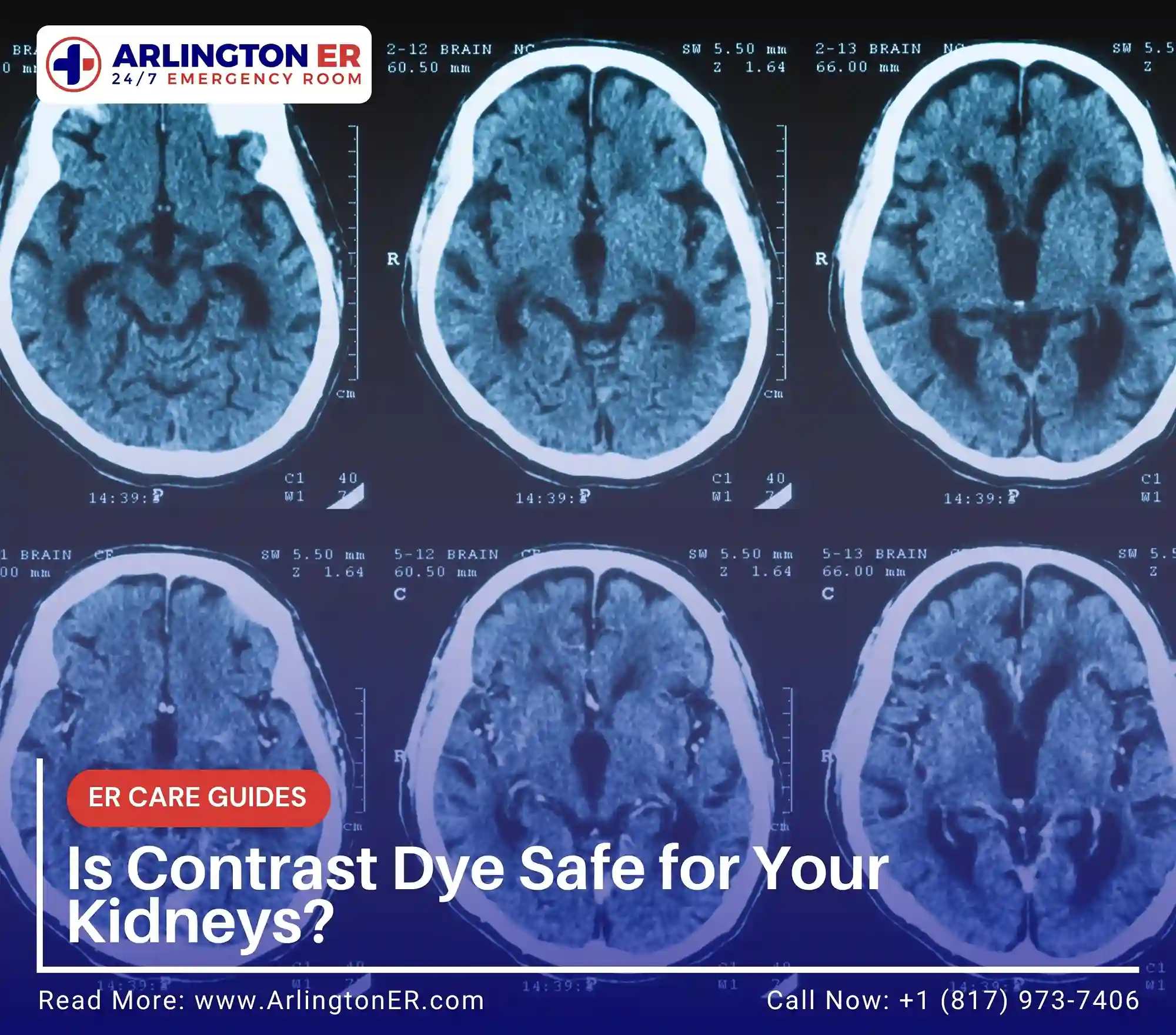
Contrast is filtered out by the kidneys, so if yours are already struggling, the calculation changes. This is why you may be asked about kidney function, or have blood drawn before the scan.
The concern has been studied hard over the last decade, and the risk to normal kidneys turned out to be smaller than once believed. For people with significantly reduced kidney function it remains a real consideration, and the decision becomes a straightforward weighing: what does this scan need to rule out, and is there another way to get the same answer.
Sometimes there is. An ultrasound or a non-contrast scan can answer some questions without it. Sometimes there isn’t, and the risk of missing a clot outweighs the risk from the contrast. At Arlington ER the scanner and the laboratory are both in the building, so that judgment is made with your blood work already in hand rather than as a guess.
Contrast Allergies and Past Reactions
Tell us before the scan, not after. If you’ve reacted to contrast before, that changes what we use and how we prepare, and it’s one of the most useful things you can tell us.
Most reactions are mild, and serious ones are rare. A shellfish allergy isn’t the same thing as a contrast allergy, despite a myth that has proved hard to kill; the iodine in contrast isn’t the reason people react to shellfish. Still mention it, because we would rather have more information than less.
Frequently Asked Questions
Neither is better. Contrast makes blood vessels and inflammation visible, so it’s used when the question involves blood flow. For kidney stones and head bleeds it would obscure the finding, so it’s left out.
No. The intravenous line is a needle stick, and the contrast itself causes a warm flush and a metallic taste for a minute or so. Those sensations are expected and pass on their own.
Often yes, usually for a few hours, and the instruction depends on the scan. In an emergency the scan may go ahead regardless, because the urgency of the answer outweighs an empty stomach.
Healthy kidneys clear most of it within about a day. Drinking normally afterward helps. No special preparation is needed unless your physician gives you specific instructions.
Tell us before the scan. Pregnancy changes both whether contrast is used and whether a CT is the right test at all, and there is sometimes an alternative that answers the same question.