
Stomach pain is the hardest symptom to judge from your own sofa. Almost everything in the abdomen can hurt, most of it is harmless, and a small share of it is genuinely urgent. From the outside they can feel remarkably similar.
Our abdominal pain emergency room in Arlington exists to answer that question properly, with CT, ultrasound and laboratory testing on site. You get a real answer in hours instead of another night of wondering whether this is the one to worry about.
Go to the ER for stomach pain that is severe, that came on suddenly, that is getting worse rather than settling, or that comes with fever, vomiting blood, black stools, a rigid abdomen, chest pain, or fainting. Pain in pregnancy also belongs here.
Most stomach aches settle by themselves and never need anyone. What separates the ones that do is usually not how bad it feels at one moment, but the direction it is heading and what is traveling with it.
A rigid abdomen deserves its own note. When the stomach wall goes hard and board-like and even light pressure is unbearable, that is a call-now situation rather than a wait-and-see one.

Where the pain sits narrows the possibilities considerably, and it is the first thing a physician asks about. It is a starting point rather than a diagnosis, but it is a useful one.
Lower right. The classic home of appendicitis, particularly when the pain began near the navel and moved there over several hours. Also where ovarian conditions announce themselves.
Upper right. Often the gallbladder, especially when the pain follows a fatty meal, comes in waves, and reaches around toward the right shoulder blade.
Upper middle, below the ribs. Stomach and duodenal problems live here, and so does the pancreas. Pain here that bores through to the back is worth taking seriously.
Either flank, radiating to the groin. Typically a kidney stone, with restless pacing rather than lying still as the giveaway.
Lower middle. Bladder and urinary causes, and in women the uterus and surrounding structures.
Everywhere at once. Widespread pain with a rigid abdomen is the pattern that concerns physicians most, because it suggests something has spread across the abdominal cavity.
One caution: pain felt in the upper abdomen can occasionally be a heart problem rather than a stomach one, particularly in older adults and people with diabetes. If it arrives with sweating, breathlessness, or chest discomfort, treat it as a cardiac emergency.

The character of the pain matters as much as its location. Pain that arrives instantly at full intensity, pain that steadily escalates over hours, and pain that makes the abdomen rigid are the three patterns that most often turn out to be emergencies.
Sudden and maximal from the first second suggests something has burst, torn, or become blocked abruptly. People often remember exactly what they were doing, because the onset was that distinct. That precision is itself a warning sign.
Steadily worsening over six to twenty-four hours is the pattern of something inflaming, and it is how appendicitis and gallbladder problems typically present. It rarely feels dramatic at first, which is why it gets tolerated for too long.
Waves of severe pain that ease and return point toward a blockage somewhere, whether in the urinary tract or the bowel. Between the waves people can feel almost normal, which makes it tempting to wait for the next one.
What is generally less worrying is pain that stays mild, comes with normal appetite, and settles gradually over a day. That is the great majority of stomach aches, and it does not need an emergency room.
With undiagnosed abdominal pain, several common home remedies genuinely make matters worse. The right-hand column is not nitpicking.
| Do this | Never do this |
|---|---|
| Note when it started and where it began | Rely on recalling the timeline later |
| Stop eating once the pain is significant | Eat a large meal to settle your stomach |
| Rest in whatever position eases it | Put a heating pad on undiagnosed pain |
| Note any fever, vomiting, or change in stool | Use a laxative or an enema to force things |
| Come in if the pain keeps escalating | Sleep on pain that is steadily worsening |
| Mention any past abdominal surgery | Leave out an operation from years ago |
Heat and anything that stimulates the bowel are the two to avoid most firmly. Both can worsen an inflamed or obstructed abdomen, and neither is safe until somebody knows what is causing the pain.
That last row matters more than people expect. Previous abdominal surgery is one of the most common reasons a bowel becomes obstructed later in life, sometimes decades afterwards. Please mention it even if it feels like ancient history.
Your physician takes the history, examines the abdomen systematically, runs bloodwork and urine testing, uses CT or ultrasound to see inside, works to ease the pain, and either identifies the cause or rules out everything dangerous before you go home.
When it started, where it began, how it moved, and what makes it better or worse. This shapes everything that follows.
Each region is examined in turn. How the abdomen responds to pressure narrows the field considerably.
Infection markers, liver and pancreas values, kidney function, and a pregnancy test where relevant. Results in minutes.
CT or ultrasound, chosen to fit the question and the patient, both available here at any hour of the night.
Work to ease the pain, and fluids through a vein when nausea has stopped you drinking anything.
Either a diagnosis and a plan, or confirmation that nothing dangerous is present, with clear instructions for what comes next.
This happens often, and it is not a failure. A meaningful share of people who come in with abdominal pain leave without a specific diagnosis, and emergency physicians have a specific term for that outcome precisely because it is so common.
What it means is worth understanding, because it sounds unsatisfying and is actually reassuring. The emergency room’s first job is not to name every ache. It is to establish that nothing present requires urgent treatment. When the examination, the bloodwork and the imaging are all normal, the dangerous causes have been excluded, and that is genuinely useful information.
Many of these pains settle on their own within a day or two. Some turn out to have causes better chased through a gastroenterologist or your own doctor over the following weeks, using tests that no emergency room performs.
What you should leave with is a clear plan: what was ruled out, which specific symptoms would mean returning, and who to follow up with. If the pain changes character, worsens, or brings a fever, come back. A second visit for the same pain is entirely appropriate, and the picture is often clearer the second time.
Nobody should go home feeling dismissed. If you are not sure what was excluded or what happens next, ask before you leave.
The workup starts with what could harm you tonight, then works outward. Comfort matters, but safety comes first.
Ultrasound where it answers the question, CT where it will not. Children and pregnancy change the order.
The old idea that easing pain hides the diagnosis has been abandoned. Comfortable patients are examined better, not worse.
If we cannot name it, we say so, tell you what was excluded, and give you a clear plan rather than a vague reassurance.
Yes, and this is one of the most common reasons people delay. A normal temperature does not rule out anything serious. Blockages, torsions, stones, bleeding, and tears in the digestive tract can all be severe with no fever at all.
Fever appears when the body mounts an inflammatory or infectious response, which takes time and does not happen in every condition. Something that has become twisted or obstructed can be urgent within hours while the thermometer stays stubbornly at normal.
Older adults complicate this further, because the fever response weakens with age. A serious abdominal infection in someone in their seventies may produce only mild pain and no temperature at all, while the underlying problem is advancing steadily.
So use the fever as a reason to come in, never as permission to stay home. Severe pain, escalating pain, or pain with vomiting deserves assessment regardless of what the thermometer says.
An abdominal pain visit is billed as an emergency visit plus whichever tests your physician orders. We bill most major private insurance plans and file the claim for you. Arlington ER is out-of-network for all private plans, but under the federal No Surprises Act an emergency visit is still processed at your in-network cost-sharing, so your share depends on your own deductible and coinsurance
Abdominal pain has a billing characteristic worth naming honestly, because it is the source of most complaints we hear about. This is the condition most likely to require several tests at once, since so many organs sit in the same space and the only way to tell them apart is to check. A visit can involve bloodwork, urine testing, an ultrasound and a CT, and each appears as its own line.
That feels expensive when the answer comes back normal, and we understand why. But the tests are what produced the reassurance. Being told nothing dangerous is happening only means something because the dangerous possibilities were actually looked for. A cheaper visit that skipped the imaging would have told you nothing.
Your physician orders what the presentation calls for and not more, and will explain why each test is being done if you ask. The federal No Surprises Act protects patients from surprise bills for emergency care. Our Patient Billing Advocates go through your Explanation of Benefits line by line, and our Financial Support and Care Relief Program can reduce or remove out-of-pocket costs for those who qualify. See our Billing Disclosure page.
For billing questions: 817-973-7406 or info@arlingtoner.com
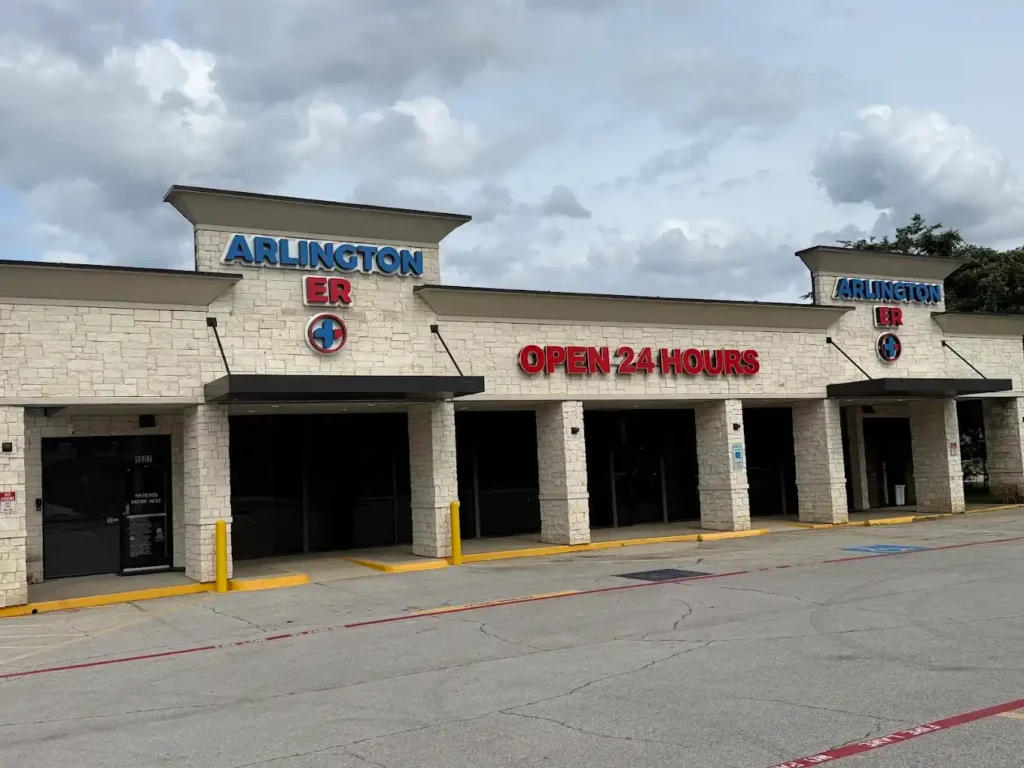
Arlington ER serves Arlington, Texas from 1607 S. Bowen Rd., on the west side of Bowen just south of Pioneer Parkway. Parking sits directly outside the entrance, which matters when every step and every bump in the road hurts.
We are minutes from central Arlington and the Parks Mall, and a short drive from Dalworthington Gardens, Kennedale, Grand Prairie, and Mansfield. From I-20, exit at Bowen Road and head north. From Highway 303 or Pioneer Parkway, turn south onto Bowen and we are on your right. Our Contact Us page has anything else you need.
Please have someone drive you if the pain is severe. We are open every hour of every day, holidays included, with no appointment or referral required.
Nobody can diagnose their own abdomen from the sofa, and the internet is worse at it than you are. If the pain is severe, escalating, or frightening you, walk in and let us look properly.
Usually two to four hours. The examination and bloodwork move quickly, and imaging adds time. How long depends on how many possibilities have to be excluded.
Severe or worsening pain belongs in an ER, because most urgent care clinics have no CT scanner and cannot exclude the dangerous causes. Mild, settling pain is reasonable for urgent care.
Better not to once the pain is significant. If an operation or certain tests turn out to be needed, an empty stomach avoids a delay. Small sips of water are usually fine.
Come in if a child has severe pain, will not walk or walks bent over, has a swollen abdomen, is vomiting green material, or is unusually quiet and refusing food.
Come back, particularly if it is worse or different. Abdominal conditions often declare themselves more clearly on a second look, and a repeat visit is entirely appropriate.
A photo ID and insurance card if handy, a note of any past abdominal surgery, and the timeline of the pain. Never delay coming in to gather paperwork.
Yes. Ask at discharge and we send results and imaging to your primary care physician or specialist, and hand you a copy so any follow-up never waits on paperwork.
Strictly the address is Pantego, a small municipality entirely surrounded by Arlington. In practical terms we are an Arlington emergency room: S. Bowen Rd. is minutes from the centre and most of our patients live in Arlington.
Medically reviewed by Rahman Mohammed, MD | Last Updated: August 22, 2026