
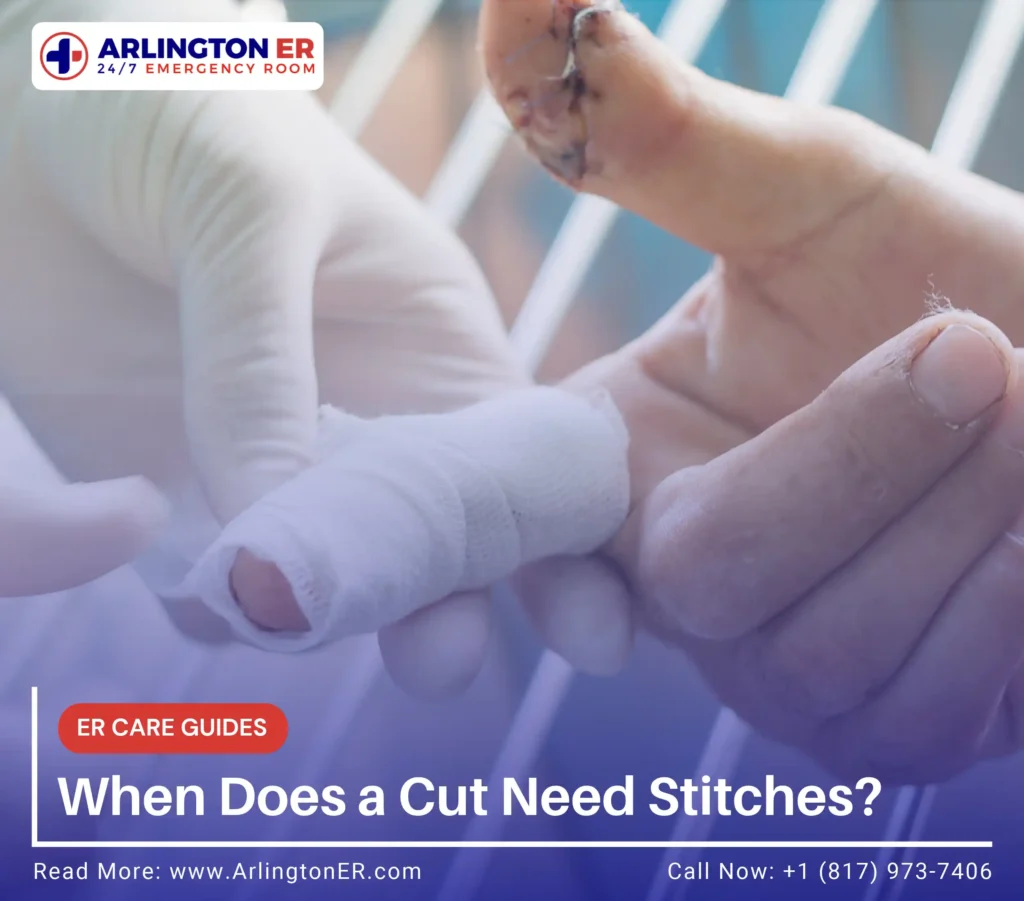
You’re holding a kitchen towel against your hand, lifting it every few seconds to look, and trying to work out whether this is a bandage situation or a get-in-the-car situation.
There’s a simple test for that, and there’s also a clock running that most people don’t know about.
When does a cut need stitches?
A cut needs stitches when the edges won’t sit together on their own. Clean it, let the skin relax, and look. Edges that meet neatly will usually heal fine with a dressing. Edges that gape open need help to close, and no bandage will hold them there.
Beyond that test, a few things make it a yes without much debate:
- Deeper than about a quarter of an inch, or you can see fat, muscle or anything below the skin
- Still bleeding after ten full minutes of firm, uninterrupted pressure
- On the face, lips or eyelid, where the scar matters as much as the healing
- Across a knuckle, knee, elbow or any joint that bends and pulls the wound open
- Caused by something dirty, rusty or by an animal or human bite
- Numbness, tingling, or you can’t move the finger or toe past the cut properly
How long do you have to get stitches?
Most cuts close best within six to eight hours, and up to about twelve on the face. After that the wound edges start to swell and the bacteria count climbs, and closing it can seal an infection inside instead of keeping one out.
This is the part worth acting on. A cut that would have taken four stitches at nine in the evening can turn into a wound that has to be left open and packed by the following morning. Waiting until the clinic opens is the single most common reason a repairable cut doesn’t get repaired.
Which cuts are fine to handle at home?
Most of them, honestly. A shallow cut with edges that meet, that stops bleeding under pressure, that isn’t on a joint or a face and wasn’t caused by anything filthy, will heal perfectly well with clean water, a dry dressing and a few days of patience.
Two habits are worth dropping while you do it. Don’t lift the cloth every minute to check, because each look tears away the clot that was forming, and ten interrupted minutes of pressure stops almost nothing. And skip the hydrogen peroxide. It kills the healthy cells trying to repair the wound right alongside the bacteria, and it measurably slows healing. Clean running water genuinely does better.
Take rings off early, too. Hands swell fast, and a ring that slides off in the first ten minutes can need cutting off two hours later.
What happens if you come in?

The wound gets cleaned properly under good light, numbed, and closed with whatever suits it. Stitches, staples, skin adhesive or strips, chosen by what the wound needs rather than by habit. A clean straight cut on a child’s forehead often does better with adhesive. A knee that bends needs stitches.
If something might still be in there, an X-ray settles it before anything is closed. Arlington ER handles laceration repair around the clock with no appointment, and taking the stitches out later is part of the same repair rather than a second visit to arrange. Kids get seen in the same building, by the same pediatric emergency care team, which saves a transfer at the worst possible moment.
What if there’s glass or metal in it?
Leave it exactly where it is. Pulling it out feels like the obvious first move, and it’s usually the wrong one, because the object itself may be holding back bleeding and tugging on it often snaps a fragment off deeper in the tissue.
Cover it, keep the area still, and come in as you are. Foreign body removal is quick with proper instruments and imaging, and a great deal slower once a piece has migrated. Fragments of glass in particular are easy to miss by feel and easy to find on film.
Frequently Asked Questions
Roughly a quarter of an inch is the usual mark, but depth alone isn’t the deciding factor. A shallow cut that gapes open still needs closing, and a deeper one on loose skin sometimes doesn’t.
Household glue isn’t made for skin and shouldn’t go near a wound. Adhesive strips are fine on a shallow cut whose edges already meet, but they hold nothing closed that wants to open.
Possibly. Bleeding stopping is good news about the blood vessels, not about the wound edges. A knuckle cut can stop bleeding in two minutes and still pull apart every time you make a fist.
Worth asking about if your last one was more than five years ago and the cut was dirty, outdoors or caused by anything rusty. Bring what you remember and we can sort it out at the same visit. The CDC explains why dirty wounds raise the risk.
Any cut through the full thickness of skin leaves some mark. What changes the result is how neatly the edges are brought together, and how early, which is why that six to eight hour window is about appearance a year from now. MedlinePlus covers home care.