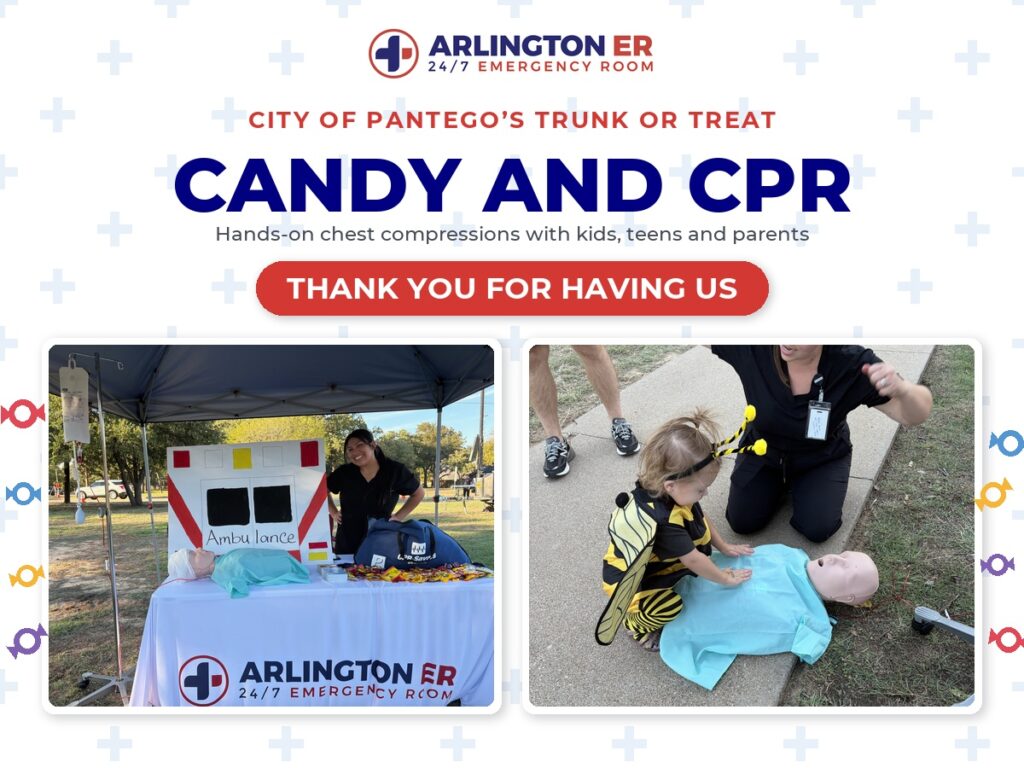
The City of Pantego held its Trunk or Treat on Saturday, and we were glad to be invited. We brought a lot of candy. We also brought a CPR mannequin and laid it on the sidewalk, which is not the usual thing to find between a bowl of candy and a costume contest.
It stayed busy all afternoon. Children, teenagers and a good number of parents knelt down and tried chest compressions for the first time. A bee, a Minion, Spider-Man and a ninja all took a turn.
What happened on Saturday
Our team set up a table, handed out candy, and spent most of the afternoon talking to people who stopped because they wanted to know what the mannequin was for.
The answer is simple. The person most likely to be standing next to someone whose heart stops is not a paramedic. It is a husband, a daughter, a neighbor or a coworker. What that person does in the first few minutes matters more than almost anything that happens afterward.
So rather than hand out a leaflet about it, we let people try.
What hands-only CPR actually is
Hands-only CPR is exactly what it sounds like. No rescue breaths, no mouth-to-mouth, no equipment. You push hard and fast in the center of the chest and you keep going until help arrives.
The things people get wrong are usually the same three:
They push too gently. Proper compressions go about two inches deep in an adult, which feels alarming the first time. It is meant to.
They push too slowly. The rate is around one hundred to one hundred and twenty a minute, which is faster than most people guess.
They stop too soon. Compressions only work while they are happening. Every pause lets the pressure drop again.
None of that is complicated. It is just unfamiliar, which is the whole reason for putting a mannequin on a sidewalk where people are already standing around.
What to do when an adult collapses
If an adult suddenly collapses in front of you and is not responding normally or not breathing properly, three things happen in this order.
Call 911, or tell a specific person to call. Pointing at someone and saying “you, call 911” works far better than asking a crowd.
Start compressions. Center of the chest, hard and fast, and do not stop to check whether it is working.
Send someone for an AED if there is one nearby. Many public buildings have one, and they are designed so that an untrained person can use them by following the spoken instructions.
Starting compressions before help arrives makes a real difference to whether someone survives. Doing them imperfectly is far better than not doing them at all, and you cannot make the situation worse by trying.
When compressions alone are not the right answer
This is the part that gets left out, and it matters.
Hands-only CPR is intended for an adult who collapses suddenly in front of you. It is not the right approach for a child or an infant, or for someone whose heart has stopped because of drowning, choking or a breathing problem. In those cases the person needs rescue breaths as well as compressions, because the underlying problem is oxygen rather than circulation.
If you are not sure which situation you are in, the 911 dispatcher will talk you through it. They do this every day and they will stay on the line.
Why an emergency room brought a mannequin to a candy event
Because the people who need this are not the people who come to training courses.
We see the other end of this at Arlington ER. By the time someone reaches us, whatever happened in those first few minutes has already happened. We cannot change it, and the difference between a good outcome and a bad one was often decided before anyone in scrubs was involved.
An afternoon where a few dozen people in costume push on a plastic chest for the first time is not a training course and nobody left certified. But they now know what it feels like, roughly how hard and how fast, and that they are allowed to start. That is most of the barrier gone.
If chest pain or breathing trouble is what brought you here rather than cardiac arrest, our chest pain page covers what to watch for and when it needs to be seen.
Where to find us
Arlington ER is at 1607 S Bowen Rd in Pantego, open 24 hours a day with no appointment needed. You can see the full list of our emergency services, and the other places we turn up in the community.
Thank you to the City of Pantego for having us, and to everyone who stopped at the table to say hello.
Frequently Asked Questions
No. Anyone can start compressions, and in an emergency you should. Certification helps you feel more confident, but it is not a requirement and nobody will ask.
It happens, and it is not a reason to stop. A broken rib heals. Cardiac arrest without compressions usually does not have an outcome you can recover from.
If they do not respond when you speak to them or shake them, and they are not breathing normally, treat it as cardiac arrest and start. Occasional gasping is not normal breathing.
No. Children and infants need rescue breaths as well as compressions, because the cause is usually a breathing problem rather than a heart rhythm problem. Call 911 and follow the dispatcher’s instructions.
We are not a training center, but we take the mannequin to community events like this one. Follow us to hear where we are going to be next.