Your physician says you need a scan, and you nod. Later that evening the questions start. Was that the right scan? Should I have asked for the other one? If you have ever been handed a result you did not fully understand, you already know how unsettling that gap feels.
Here is the short version. A CT scan is fast and sees bleeding, bone, and organs. An MRI is slow and sees soft tissue in far greater detail. They are not competing versions of the same test. They answer different questions, and the question you arrive with decides which one you get.
At Arlington ER we run a GE VCT 64-slice CT scanner on site, alongside ultrasound, X-ray, and a full laboratory. When someone walks in with a symptom that needs an answer tonight, we image and interpret it here rather than sending it elsewhere and waiting.
The Short Answer: CT for Speed, MRI for Detail
Choose a CT scan when the question is urgent. Bleeding in the brain, a suspected clot in the lung, appendicitis, a kidney stone, or a fracture an X-ray could not settle. A CT study takes seconds.
Choose an MRI when the question is about soft tissue and is not an emergency. A torn ligament, a disc pressing on a nerve, or fine detail inside the brain. An MRI takes twenty to sixty minutes and is usually booked in advance.
Everything below explains why that difference exists.
How a CT Scanner Works?
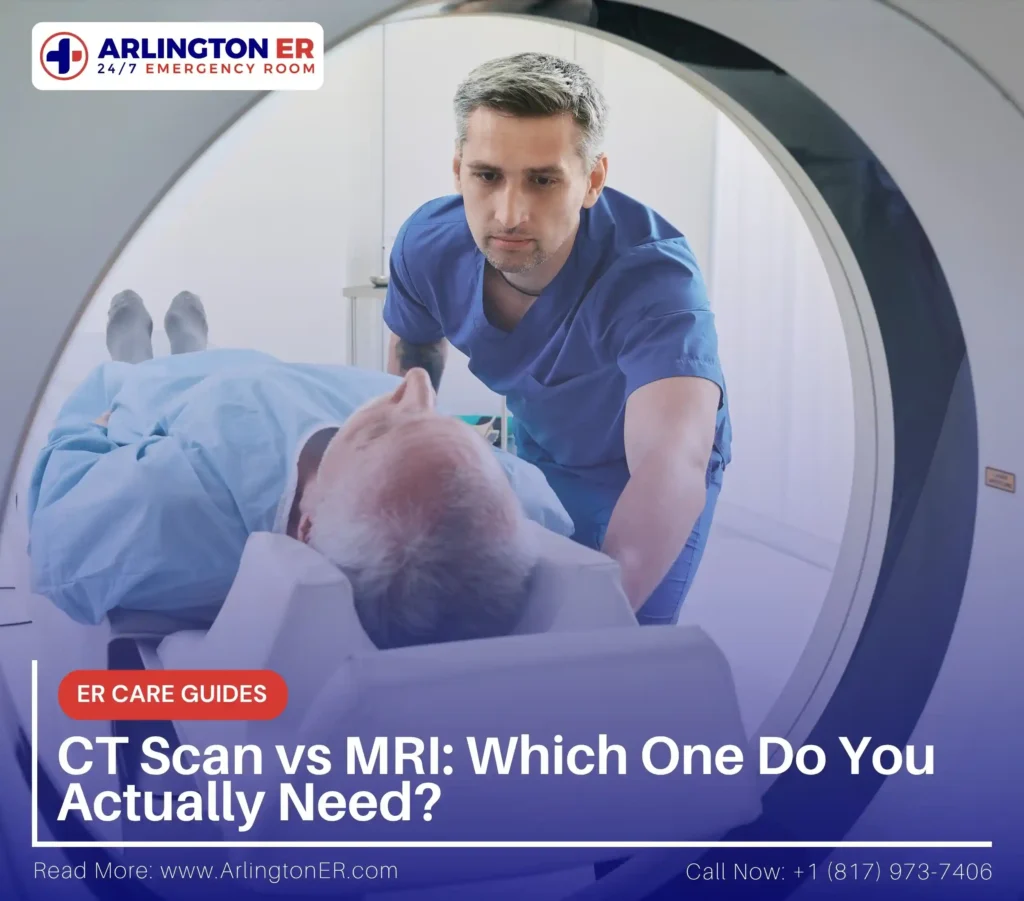
A CT scanner is an X-ray machine that builds pictures in three dimensions. It passes X-rays through the body from many angles and reconstructs them into cross-sections, called slices.
Our scanner is a 64-slice machine, which means it captures 64 of those cross-sections in a single rotation. In practice that turns a scan of the head into a study measured in seconds, not minutes. You lie still, the table moves, and it is finished before most people have settled.
How an MRI Works?
An MRI uses no X-rays at all. It uses a powerful magnet and radio waves to make the water in your tissue give off a faint signal, then builds an image from that signal.
There is no radiation, which is a genuine advantage. There is also no speed. You lie inside a narrow tube, it is loud, and you have to stay very still for the whole study. Metal in the body, including some implants and pacemakers, can rule an MRI out entirely, because the magnet is strong enough to move it.
What a CT Scan Sees Best
CT is best at anything dense, and anything urgent.
It shows bone with great clarity, which makes it the test for a complicated fracture. It shows fresh bleeding, which is why it is the first scan in a suspected stroke or a serious head injury: blood in the brain appears bright and obvious the moment the images come up. It covers the chest and abdomen well enough to identify appendicitis, kidney stones, obstructions, and internal injuries in one pass.
In our experience the speed matters more than any other single factor. When someone arrives with stroke symptoms, treatment depends on knowing whether the cause is a clot or a bleed, and those two require opposite responses. A scan that finishes in seconds allows that decision now. A scan that takes forty minutes does not.
What an MRI Sees Best
MRI is best at soft tissue and fine detail.
Ligaments, tendons, cartilage, discs, the spinal cord, and the finer structures of the brain all show up in a way CT cannot match. A torn knee ligament, a slipped disc pressing on a nerve, or the precise margins of a tumor are MRI questions.
It is also the better choice for anyone who needs imaging repeatedly over months or years, since there is no radiation to accumulate.
CT Scan vs MRI: Side by Side
| CT Scan | MRI | |
| How it works | X-rays from many angles | Magnet and radio waves |
| Time | Seconds to a few minutes | 20 to 60 minutes |
| Radiation | Yes, a small dose | None |
| Best for | Bleeding, bone, chest, abdomen, and anything urgent | Ligaments, discs, spinal cord, and fine brain detail |
| Where you get one | Emergency rooms and imaging centers | Usually scheduled at an imaging center |
| Main limitation | Less detail in soft tissue | Slow, enclosed, and metal can prevent it |
Is a CAT Scan the Same as a CT Scan?
Yes. They are the same test. The original name was computerized axial tomography, shortened to CAT. The technology moved past the axial part, so most departments now say CT. If one leaflet says CAT and your physician says CT, nothing has changed.
What About the Radiation in a CT Scan?
The radiation dose from a single CT study is small. It is far smaller than the risk of missing a bleed, a clot, or a rupture. Radiation is a good reason to avoid an unnecessary scan. It is not a reason to avoid a necessary one.
Where it deserves real weight is in children, in pregnancy, and in anyone who has already had a great deal of imaging. In those situations we look first for an alternative that answers the same question, which is why ultrasound is usually the first imaging test in pregnancy and often the first in children. You can read more about our emergency ultrasound imaging services and when we choose them. Ultrasound uses sound waves and carries no radiation at all.
| Worth asking your physician: “What is this scan looking for?” It is a better question than “which machine is better,” and it usually produces a much clearer explanation. Every scan is ordered to answer something specific. Knowing what that is tells you more than the name of the equipment. |
Why the Emergency Room Almost Always Chooses CT?
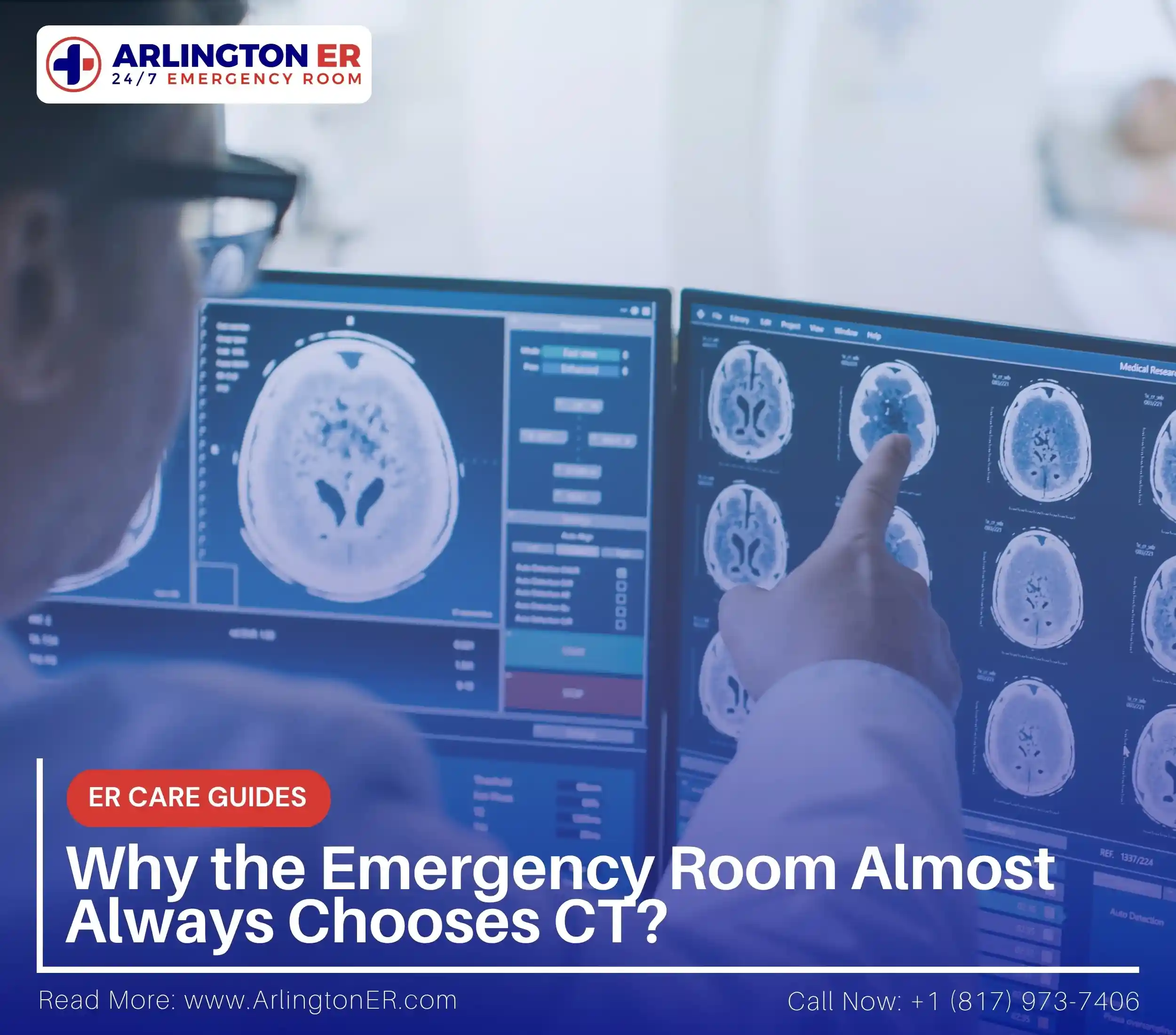
Emergency questions are urgent, and CT answers urgent questions. Is there blood in the brain. Is the appendix inflamed. Is there a clot in the lung. Is the bowel obstructed. Every one of those needs an answer within minutes, and every one of them is a CT question.
MRI questions are rarely emergencies. A torn ligament hurts and it matters, but it does not change what happens tonight. That is a scan to arrange properly, with a specialist reading it.
There are exceptions. Some spinal cord problems need urgent MRI, and in those cases we coordinate transfer to a facility with the right scanner rather than making do with the wrong one.
What to Do If You Have Been Told You Need a Scan?
If it is a routine scan for something that has been going on for months, book it at an imaging center. It will cost you less, and you will not be paying for emergency capability you do not need. We would rather tell you that than take a visit you did not need.
If your symptoms are new, severe, or getting worse, that is a different situation. Arlington ER is open every hour of every day at 1607 S Bowen Rd in Pantego, minutes from central Arlington. A physician assesses you first and images when imaging is what the situation calls for. Learn more about our emergency CT scan services in Arlington, including what the scan shows and how quickly results are read. No appointment, and no referral.
Frequently Asked Questions
You can ask, but the choice follows the question being asked rather than preference. A physician orders the scan that answers what needs answering, and will explain why that one was chosen.
Most freestanding emergency rooms, including ours, have CT, ultrasound, and X-ray rather than MRI. Emergency questions almost always need speed, and MRI is the slowest of the four.
For sudden symptoms, CT, because it shows bleeding immediately. For detailed structural questions that are not urgent, MRI. They are used at different points in the same story.
Contrast is a dye that makes blood vessels and certain tissues stand out. Whether you need it depends on what the scan is looking for, and your physician will explain the reason before it is given.
The scan itself takes seconds. What takes longer is the assessment before it and the interpretation afterward, both of which happen on site here.