
Most bronchitis does not need an emergency room, and we will tell you so plainly. It is a cough that outstays its welcome by two or three weeks, and the great majority of it clears on its own.
What brings people here is the uncertainty. A cough that will not stop, a chest that feels tight, and no way to know from the sofa whether this is bronchitis or pneumonia. A chest X-ray answers that in minutes, and we have one on site around the clock.
The symptoms of bronchitis are a persistent cough that may bring up clear, yellow or green phlegm, chest tightness or soreness from coughing, wheezing, mild breathlessness on exertion, and tiredness. A low fever is common early on and usually settles within a few days.
The defining feature is how long it lasts. A cold clears in a week; bronchitis leaves a cough behind for two to three weeks and sometimes longer, which is what drives people to seek help long after they otherwise felt better.
Worth knowing: the color of phlegm does not tell you whether an infection is bacterial. Green phlegm is a normal part of viral bronchitis and on its own is not a reason for antibiotic treatment.
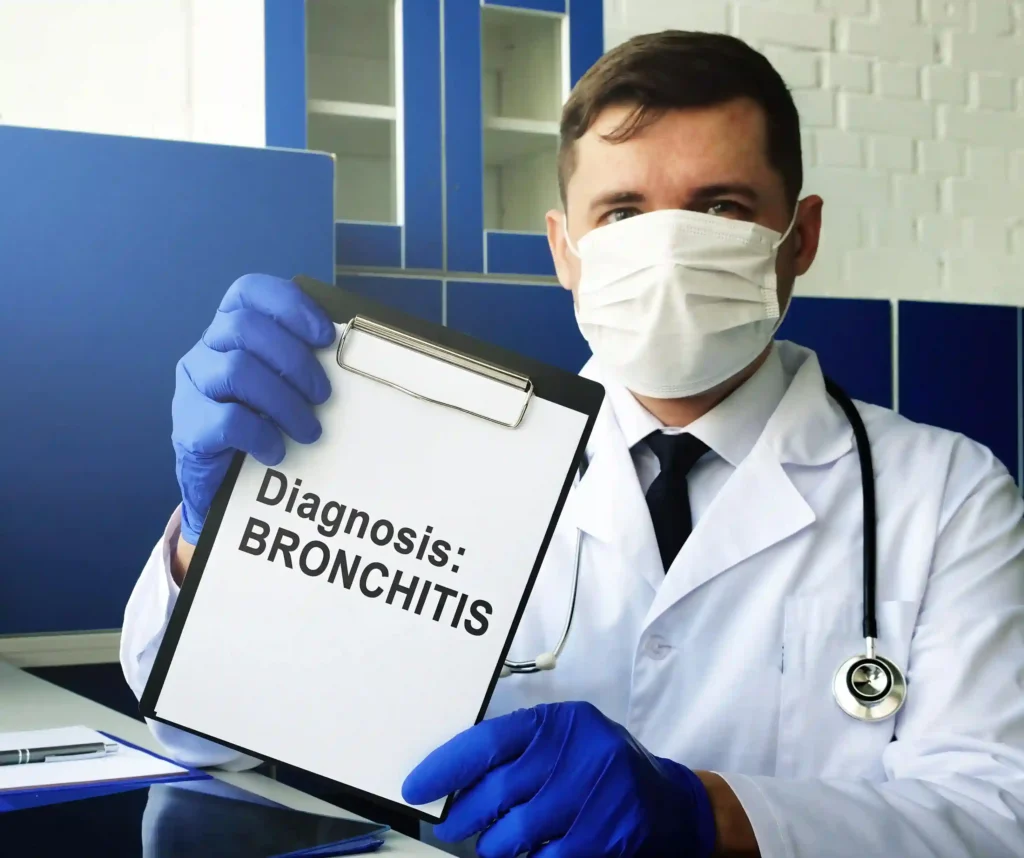

You cannot know for certain without a chest X-ray, and that is the honest answer. What tilts the picture toward pneumonia is breathlessness at rest, a high fever that will not settle, shaking chills, and sharp chest pain when you breathe in rather than when you cough.
Bronchitis irritates the airways. Pneumonia infects the lung tissue itself. That difference is invisible from outside but obvious on an X-ray: bronchitis leaves the film looking normal, while pneumonia shows an area of lung that should be dark and is not.
A few practical distinctions help. Bronchitis usually leaves you feeling reasonably well between coughing fits. Pneumonia tends to make you feel genuinely ill throughout. Bronchitis makes your chest sore from the effort of coughing; pneumonia often hurts when you simply breathe in deeply.
If a physician listens to your chest and hears nothing to suggest pneumonia, and you are breathing comfortably with normal oxygen levels, an X-ray may not be needed at all. When there is doubt, taking the film is quicker than wondering about it for another week.
Rarely, and only when the breathing itself is affected. Come in for breathlessness at rest, coughing up blood, a fever above 102 that will not settle, chest pain when breathing in, or wheezing severe enough that talking is difficult.
An ordinary bronchitis cough, however exhausting, is not an emergency. It is a clinic problem or often no problem at all beyond patience. Being straightforward about that is more useful to you than encouraging a visit you do not need.
The exception worth naming is anyone with an existing lung condition. Bronchitis on top of asthma or chronic lung disease can tip breathing from manageable to difficult quite quickly, and that group should have a much lower threshold for being seen.
The other reason people come, and a legitimate one, is a cough that has gone on for three weeks or more with no sign of improving. At that point it deserves a look, because a small number of those turn out to be something other than bronchitis.
Because the overwhelming majority of acute bronchitis is caused by a virus, and antibiotic treatment does nothing against viruses. This is the single most common disagreement between patients and physicians about this illness, so it is worth explaining properly rather than just asserting.
The reasoning is straightforward. Antibiotic treatment works against bacteria. Roughly nine in ten cases of acute bronchitis are viral, which means for most people it offers no benefit at all: the cough lasts the same number of days either way.
What it does bring is downside. Upset stomach, diarrhea, allergic reactions, and a contribution to resistance that makes treatment less effective for everyone later, including for you the next time you genuinely need it.
Green phlegm is the detail that convinces people otherwise, and it is genuinely misleading. That color comes from your own immune cells breaking down, not from bacteria. Viral bronchitis produces green phlegm routinely.
There are real exceptions. Bronchitis in someone with significant lung disease, a case that is clearly worsening after several weeks, or a picture suggesting pneumonia rather than bronchitis may well warrant treatment. Your physician weighs those individually.
If we tell you antibiotics will not help, it is not a shortcut or a cost decision. It is the answer that gets you better without adding a risk that buys you nothing.
Almost all of bronchitis is managed at home, so this table matters more here than on most of our pages.
| Do this | Never do this |
|---|---|
| Drink plenty, which loosens the phlegm | Expect the cough to stop within a week |
| Use a humidifier or breathe steam from a shower | Smoke, or stay in a room where others do |
| Rest, particularly in the first week | Push through heavy exercise while wheezing |
| Sleep propped up if coughing wakes you | Suppress a productive cough all night long |
| Note the date the cough started | Take leftover antibiotics from a past illness |
| Come in if breathing becomes difficult | Ignore a cough still going at four weeks |
Smoking is the single biggest factor in how long this lasts. Continuing to smoke through bronchitis roughly doubles the recovery time and considerably raises the chance of it returning next winter.
On the fourth row: a cough that brings something up is doing a job. Suppressing it entirely at night can leave phlegm sitting in the airways, so sleeping propped up is usually the better answer than silencing it.
Your physician measures oxygen, listens to your chest, takes an X-ray if pneumonia is a genuine possibility, opens the airways where wheezing is significant, and explains honestly whether treatment beyond rest will help you.
A clip on the finger. Normal oxygen with a bad cough is reassuring in a way no description can be.
Wheezing throughout suggests airways. A focal patch of abnormal sound suggests lung, and changes the plan.
Not routine. Taken when the examination, fever or breathlessness raises a real question of pneumonia.
Where wheezing is significant, breathing treatment can ease the tightness during the visit itself.
If antibiotic treatment will not help you, we explain why rather than prescribing to end the conversation.
Written guidance on the signs that would mean returning, and a realistic timeline for the cough.
Expect two to three weeks for the cough, and understand that a minority of people cough for six weeks or more. The fever and general unwellness usually pass within the first week, which is what makes the lingering cough so frustrating.
The reason it drags is that the airway lining has been inflamed, and healing takes considerably longer than clearing the infection did. During that period the airways stay twitchy, so cold air, exercise, or a lungful of dust can set off a coughing fit weeks after you otherwise felt well.
That is normal, and it is not a sign the illness was mistreated or that you need something stronger. Most people asking why they still have a cough are simply at day eighteen of a process that takes twenty-one.
What is not normal is getting worse rather than slowly better, developing a new fever after the first one settled, or coughing up blood. Any of those means come back and be reassessed rather than waiting out the timeline.
If the cough is still there at eight weeks, that is worth investigating properly with your own doctor. At that point the question changes from how long bronchitis lasts to whether this was ever bronchitis.
That is the question worth an emergency room. Everything else about bronchitis can be managed elsewhere.
Antibiotic treatment for viral bronchitis adds risk and no benefit. We explain that rather than taking the easy route.
Bronchitis on top of asthma or chronic lung disease is a different illness, and it is assessed as one.
A three-week cough in a well person belongs with your own doctor. We will tell you that instead of taking the visit.
A bronchitis visit is billed as an emergency visit, plus a chest X-ray only if your physician orders one. We bill most major private insurance plans and file the claim for you. Arlington ER is out-of-network for all private plans, but under the federal No Surprises Act an emergency visit is still processed at your in-network cost-sharing, so your share depends on your own deductible and coinsurance.
This is the page where we are least likely to tell you that you needed us. Bronchitis is the most common reason people visit an emergency room for something a clinic would handle better and cheaper, and saying that clearly is more useful than letting you discover it afterward.
What you are actually paying for here, when it is warranted, is one specific thing: ruling out pneumonia with an X-ray, tonight, without waiting for an appointment. If breathing is affected, if a fever will not settle, or if you have a lung condition already, that answer is worth having quickly and a clinic cannot provide it.
If you are otherwise well and simply exhausted by a three-week cough, your own doctor is the better route. We will assess you gladly if you come, and we will also tell you plainly if that is what you should have done.
The federal No Surprises Act protects patients from surprise bills for emergency care. Our Patient Billing Advocates will work through your Explanation of Benefits with you, and our Financial Support and Care Relief Program can reduce or remove out-of-pocket costs for those who qualify. See our Billing Disclosure page.
Arlington ER runs the BioFire SpotFire respiratory panel on site. It is a molecular test that checks for up to 15 respiratory infections from a single swab, with results in about 15 minutes. Most clinics still use an older antigen test that checks for one or two infections and misses more cases.
For billing questions: 817-973-7406 or info@arlingtoner.com

Arlington ER serves Arlington, Texas from 1607 S. Bowen Rd., on the west side of Bowen just south of Pioneer Parkway. Parking is directly outside the entrance, so there is no long walk while you are coughing.
We are minutes from central Arlington and the Parks Mall, and a short drive from Dalworthington Gardens, Kennedale, Grand Prairie, and Mansfield. From I-20, exit at Bowen Road and head north. From Highway 303 or Pioneer Parkway, turn south onto Bowen and we are on your right. Our Contact Us page has anything else you need.
Please wear a mask on arrival if you can. We are open every hour of every day, holidays included, with no appointment or referral required.
If you are breathless at rest, coughing up blood, or your chest hurts when you breathe in, that needs an X-ray tonight rather than another week of waiting. Walk in and let us settle it.
The virus that caused it is, particularly in the first week. What someone else catches may be an ordinary cold rather than bronchitis, since the same virus affects different people differently.
No. The color comes from your own immune cells, not from bacteria, and viral bronchitis produces green phlegm routinely. It is one of the most persistent myths about this illness.
Acute bronchitis follows an infection and clears within weeks. Chronic bronchitis means a productive cough most days for three months, two years running, and is usually related to smoking.
They are separate conditions rather than stages, but the same illness can involve both, and someone weakened by bronchitis can develop pneumonia. Getting worse after improving is the pattern to watch.
Lying flat lets phlegm settle in the airways, and the airways are naturally twitchier overnight. Sleeping propped on an extra pillow usually helps more than anything taken by mouth.
During the first few days while you have a fever, yes. Once the fever has gone and you feel reasonably well, the lingering cough alone need not keep you at home.
Not for every cough. It is warranted when there is fever, breathlessness, chest pain on breathing in, or an abnormal examination. A normal chest and normal oxygen often means no film is needed.
A cough beyond about eight weeks deserves proper investigation with your own doctor. At that point the question is no longer about bronchitis but about what else could be causing it.
Medically reviewed by Rahman Mohammed, MD | Last Updated: August 26, 2026