
Every parent has stood in a hallway at midnight holding a hot, miserable child, trying to work out whether this is a wait-until-morning problem or a get-in-the-car problem. There is no good way to decide that alone, and the internet makes it worse rather than better.
Our pediatric emergency room takes that decision off your shoulders. Board-certified emergency physicians assess children of every age here, with on-site X-ray, CT, ultrasound, and a full laboratory, so you get an answer during the visit rather than a callback tomorrow.
Take a child to the emergency room for labored breathing, a seizure, unusual drowsiness or difficulty waking, a fever in a baby under three months, a rash that does not fade under pressure, persistent vomiting, or any injury with deformity or a head knock followed by confusion.
Beyond that list, there is a signal parents consistently underrate: how the child is behaving rather than what the thermometer says. A child who is drinking, responding to you, and interested in something on the television is usually in better shape than the numbers suggest. A child who has gone quiet, floppy, or will not make eye contact needs seeing regardless of temperature.
Call 911 for breathing that is failing, a seizure lasting more than five minutes, or a child who cannot be roused. Otherwise walk in. We would far rather see a well child than miss a sick one.


A baby under three months has an immune system that has barely started work, so an infection can spread from something minor to something serious in hours rather than days. At that age a fever is treated as an emergency until proven otherwise, no matter how settled the baby seems.
The other difficulty is that newborns cannot show you where it hurts, and they often do not look dramatically unwell even when something significant is happening. The usual warning signs older children give simply are not available yet. Sometimes the only clue is that feeding has dropped off, or that the baby has become unusually quiet.
This is why we never ask a parent to wait and see with an infant. If your baby is under three months and warm, bring them in tonight. If they are under a month, treat it as urgent regardless of the hour.
The reassuring part is that most of these visits end well. The evaluation exists to catch the small number that would not have, and there is no version of this where you were wrong to come.
For a child over three months, the number on the thermometer matters far less than parents expect. How the child looks and behaves is the better guide. A child at 103 who is drinking and alert is often less concerning than a child at 100 who has gone limp and unresponsive.
That said, some numbers do change the answer. Any temperature at all in a baby under three months needs seeing tonight. A fever lasting more than three days deserves an assessment even in a child who seems well, because something is driving it that has not declared itself yet.
What should always bring you in, at any temperature: a fever with a stiff neck, a fever with a rash that will not fade under pressure, a fever with labored breathing, or a fever in a child who cannot be kept awake enough to drink.
Fever itself is not the illness. It is the body doing its job, and the question worth answering is what set it off. That is what the visit is for.
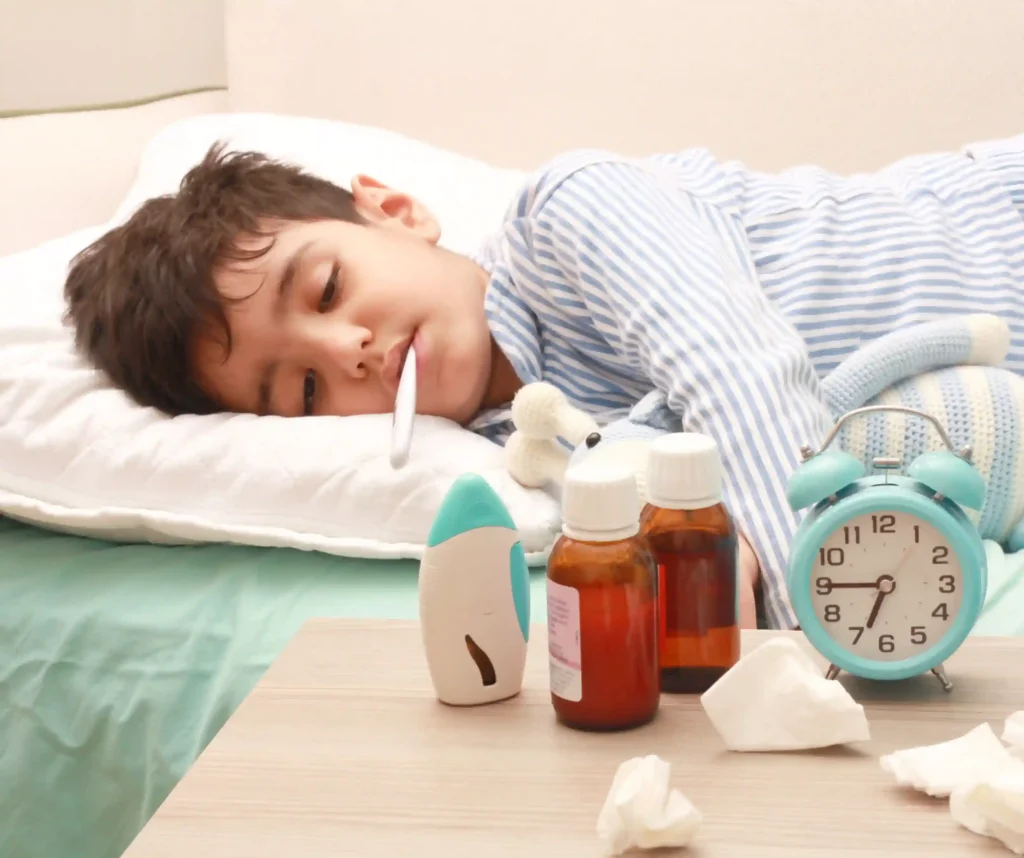
Bring a comfort item, note when the symptoms started, and keep offering small sips of fluid on the way. The second column is the part parents most often get wrong, and none of it is obvious.
| Do this | Never do this |
|---|---|
| Note when symptoms started and what you noticed first | Wait overnight to see whether it settles |
| Bring a favorite toy, blanket, or book | Tell a child the visit will not involve anything |
| Offer small frequent sips of fluid | Force large drinks on a vomiting child |
| Dress them in light layers you can remove | Bundle a hot child in blankets to sweat it out |
| Photograph a rash before it changes | Scrub or cover a rash before we see it |
| Bring the immunization record if it is to hand | Delay leaving to hunt for paperwork |
Two of those deserve a note. Photographing a rash genuinely helps, because rashes change fast and what we see at three in the morning may look nothing like what alarmed you at bedtime. And please do not promise a child that nothing will happen. Children forgive a hard truth far more readily than they forgive being misled, and a child who trusts what you say is much easier to examine.
Your child is weighed and assessed on arrival, examined by a board-certified emergency physician, and given whatever testing the picture calls for, with results read here rather than sent away. A parent stays through every step, including imaging.
Everything in pediatric care is calculated from weight, so it is measured before anything else begins.
A full head-to-toe assessment by a board-certified emergency physician, with you in the room throughout.
Bloodwork and urine testing run in our own laboratory, so results come back in minutes rather than days.
X-ray, ultrasound, and CT are all here. Ultrasound is used first in children wherever it can answer the question.
Fluids, wound care, splinting, and breathing support delivered at a size and pace suited to a child.
Most children go home with a clear plan. If admission is needed, we stabilize and arrange the transfer.
How a child looks, drinks, and responds tells us more than any single number, and it drives the assessment.
Children are more sensitive to radiation, so we reach for ultrasound first when it can answer the question.
You are not asked to wait outside for imaging or bloodwork. A familiar face makes a frightened child easier to treat.
A parent noticing this is not like her usual illnesses is real clinical information, and we treat it that way.
A child’s visit is billed as an emergency visit plus whatever testing is ordered. We bill most major private insurance plans and file the claim for you. Arlington ER is out-of-network for all private plans, but under the federal No Surprises Act an emergency visit is still processed at your in-network cost-sharing, so what you owe depends on your family plan’s deductible and coinsurance rather than a fixed price.
Children’s coverage carries one wrinkle worth checking before you need us. On many family plans a child sits on a separate deductible from the adults, and on high-deductible plans the family deductible can reset in a way parents do not expect mid-year. It is worth knowing where your child stands on that before an emergency, not during one.
Texas Medicaid and CHIP families are welcome. If you are unsure whether a plan covers a freestanding emergency room, please come in anyway and ask us afterwards. Federal protections under the No Surprises Act cover emergency care, and nobody should be reading policy documents while holding a sick child.
Our Patient Billing Advocates will work through the paperwork with you line by line, and our Financial Support and Care Relief Program can reduce or remove out-of-pocket costs for families who qualify. Your rights are set out in full on our Billing Disclosure page. No child is ever assessed for payment before being assessed for illness.
A child over three months with a mild cold, a low fever, a scraped knee, or a single episode of vomiting who is still drinking, playing between naps, and recognizably themselves will usually do fine at home with a call to your pediatrician in the morning.
The same goes for the ordinary run of childhood: teething, a mild rash that fades under pressure, an ear that hurts but is not accompanied by high fever or floppiness. Those are pediatrician conversations, and we will happily tell you so if you bring them here.
Where that guidance stops is anything on the list further up this page, anything in a baby under three months, and one more that parents talk themselves out of far too often: the feeling that something is different this time. If you have raised this child through a dozen illnesses and this one does not sit right with you, that is information no examination can replace.
Come in. We see well children every day and count it as a good outcome. Sore throats that turn out to be strep, and falls that turn out to be a broken bone, are two of the most common reasons parents bring a child in. Nobody here will make you feel foolish for checking, and no parent has ever regretted the trip that turned out to be nothing.
For billing questions: 817-973-7406 or info@arlingtoner.com

Arlington ER is at 1607 S. Bowen Rd. in Pantego, on the west side of Bowen just south of Pioneer Parkway. Parking is directly outside the entrance, which matters enormously when you are carrying a child who cannot walk and a bag you packed in a hurry.
We are minutes from central Arlington and the Parks Mall area, and an easy run from Dalworthington Gardens, Kennedale, Grand Prairie, and Mansfield. From I-20, exit at Bowen Road and head north. From Highway 303 or Pioneer Parkway, turn south onto Bowen and we are on your right. Our Contact Us page has everything you need if you would rather ring ahead.
We are open every hour of every day, holidays included, and no appointment or referral is ever required.
If something feels wrong, bring them in. We are here at three in the morning, on Christmas Day, and on every ordinary Tuesday in between, and we would rather see your child and reassure you than have you spend the night watching the clock.
Every age, from newborns through to teenagers. Our physicians are board-certified emergency doctors trained to treat the full age range, not adults alone, and children make up a large share of what we see.
Yes, throughout. You are welcome to stay for the examination, bloodwork, and imaging. A parent in the room usually makes a frightened child considerably easier to assess.
It depends entirely on what is found. A straightforward assessment moves quickly. Visits involving laboratory results, imaging, or a period of fluids and observation naturally take longer.
Coverage varies by plan, so please ask our billing team about your specific policy. Never delay bringing a sick child in while you check. Emergency care comes first and paperwork second.
Tell us on arrival. Our nurses do this every day and have plenty of ways to make it easier. It also helps if you avoid promising beforehand that nothing will happen.
Yes. Ask at discharge and we will forward the visit notes and any results to your pediatrician, and hand you a printed copy to take to the follow-up appointment.
We stabilise your child here and coordinate a direct transfer to a children’s hospital, with the receiving team briefed before you arrive. A parent travels with the child.
Bring them if there is no alternative at two in the morning. If someone can stay home with siblings, the visit is usually calmer for everyone, including the child being seen.
Medically reviewed by Rahman Mohammed, MD | Last Updated: September 23, 2026