
Adrenaline is very good at hiding injuries. People walk away from a crash feeling shaken but fine, decline the ambulance, and wake the next morning unable to turn their head or stand up straight.
Arlington ER assesses accident injuries around the clock with CT, X-ray and ultrasound on site. We also treat patients under a Letter of Protection, which means no payment at the time of service if an attorney is handling your claim.
Yes, if the crash involved any significant force, if you hit your head, if the airbags deployed, if a vehicle was towed away, or if you have any pain at all. Feeling fine at the roadside is not reliable evidence that you are uninjured.
The reason is adrenaline. In the minutes and hours after a crash your body floods with stress hormones that genuinely mask pain, which is why people give clear statements to police while walking on a fractured foot.
Anyone pregnant should be assessed after any collision, however minor it seemed. So should anyone on blood-thinning treatment, because a knock that would bruise most people can bleed slowly instead.


Because adrenaline suppresses pain for hours after a crash, and because soft tissue injuries take time to swell and stiffen. What you feel at the roadside and what you feel the next morning are frequently two different things.
Whiplash is the clearest example. The neck muscles and ligaments are stretched beyond their normal range in a fraction of a second, but the inflammation that follows builds over twelve to twenty-four hours. Most people feel their worst on day two, not day one.
Slow internal bleeding follows a similar pattern for different reasons. A small tear in an organ can leak gradually, producing pain and lightheadedness that appear hours after the crash rather than immediately.
Bleeding inside the skull behaves the same way, which is why a head injury after a collision deserves assessment even when the person seems entirely normal at the scene. That is precisely the presentation that gets sent home and comes back worse.
These are the injuries people drive home with. Each one is straightforward to find when someone looks for it, and each causes real trouble when nobody does.
Whiplash and neck injury. The most common of all. Pain and stiffness that arrive the next morning, sometimes with headache, dizziness, or tingling into the arms.
Concussion without loss of consciousness. You do not have to black out. Feeling foggy, being slow to answer, or a headache that builds through the evening all count.
Internal bleeding. Particularly across the seatbelt line. Abdominal pain, bruising in a diagonal band, or lightheadedness hours later deserve imaging rather than reassurance.
Rib and sternum fractures. Steering wheel and seatbelt injuries. They hurt most on deep breaths, and they matter because breathing shallowly for days raises the risk of a chest infection.
Wrist, knee and shoulder injuries. Bracing against the wheel and dashboard transmits enormous force through joints. These often go unnoticed until the more painful injuries settle.
Spinal injury without obvious paralysis. A fracture in the spine can be stable and quiet initially. This is the one where waiting genuinely risks something permanent.
The pattern connecting all of them is delay. Each is manageable when found early, and each becomes considerably harder to treat once weeks have passed with the wrong explanation attached to it.
What you do in the first hour affects both your health and any claim that follows. The right-hand column contains the two mistakes that cause the most trouble later.
| Do this | Never do this |
|---|---|
| Call the police and get a report number | Agree to settle it privately at the roadside |
| Photograph both vehicles and the scene | Leave before exchanging insurance details |
| Say only what you know for certain | Tell anyone you are fine before being examined |
| Get assessed the same day | Wait a week to see whether the pain settles |
| Keep every document and receipt together | Throw away paperwork that seems unimportant |
| Stay still if your neck or back hurts | Move someone with neck pain out of a vehicle |
The third row is the one that causes lasting problems. Saying I am fine at the scene, while adrenaline is masking everything, is quoted back later by insurers when symptoms appear two days on. Say instead that you have not been examined yet.
The fourth row matters for the same reason. A gap between the crash and being seen is the single most common argument used to dispute that an injury came from the collision. Being assessed the same day removes that argument entirely, quite apart from the medical benefit.
Your physician takes an account of how the crash happened, examines you from head to toe, images whatever the mechanism and your symptoms point to, treats the pain, and documents everything in a record that stands up if a claim follows.
Speed, direction of impact, seatbelt, airbag, where you were sitting. Mechanism predicts injury better than symptoms do.
Systematic rather than focused on wherever hurts most, because adrenaline hides the injuries you have not noticed.
CT, X-ray and ultrasound in the same building. Nobody is sent across town and told to come back tomorrow.
Comfort matters in its own right, and a person in less pain can be examined far more thoroughly.
A detailed record linking the crash to your injuries. This is what an attorney or insurer will rely on later.
Referral where needed, and written signs that would mean returning, since some injuries declare themselves late.
A Letter of Protection is an agreement signed by your attorney promising that our bill will be paid from your settlement. It means you can be treated today with no payment at the time of service, even without insurance.
It exists to solve a specific and common problem. Someone is injured by another driver, needs care immediately, and either has no insurance or cannot face a large deductible while their income has stopped. A Letter of Protection removes cost from that decision entirely.
How it works in practice is straightforward. You are hurt in a collision, you instruct an attorney, and your attorney sends us the letter. We treat you, hold the bill rather than pursuing you for it, and are paid when the claim resolves.
Two honest points worth understanding. You need an attorney representing you, because the letter comes from them rather than from you. And if the claim is unsuccessful, responsibility for the bill generally returns to you, so it is worth asking your attorney to explain that clearly before signing.
Full details are on our Letter of Protection page. If you do not yet have an attorney, come in and be treated anyway. Your health should not wait for paperwork, and our team can talk through the options afterward.
What the crash did to the vehicle tells us where to look, regardless of which part happens to hurt right now.
Detailed, contemporaneous records. Vague notes cost patients real money months later when a claim is disputed.
No payment at the time of service when an attorney is handling your claim. Cost does not decide whether you are seen.
Your attorney or insurer will request them. We turn those requests around promptly rather than sitting on them.
Care after a collision is billed as an emergency visit plus the imaging your physician orders, and it usually involves more imaging than other visits because several body regions may need checking.
Accident care has a payment structure unlike anything else on this site, and understanding it is genuinely worth a few minutes. There are three routes, and which applies to you changes the answer completely.
Through a Letter of Protection. If an attorney is handling your claim, nothing is paid at the time of service. The bill waits and is settled from the claim.
Through your own health insurance. Billed like any emergency visit, with your usual deductible and coinsurance applying. Many people do this and let the claim reimburse them afterward.
Through auto insurance. Texas policies often include medical payments coverage that pays for injury care regardless of fault. Many people do not know they have it. It is worth checking your own policy before assuming you are uninsured for this.
The federal No Surprises Act protects patients from surprise bills for emergency care. Our Patient Billing Advocates handle accident claims regularly and will walk you through which route fits your situation. Our Financial Support and Care Relief Program can also reduce out-of-pocket costs for those who qualify, and full details are on our Billing Disclosure page.
For billing questions: 817-973-7406 or info@arlingtoner.com
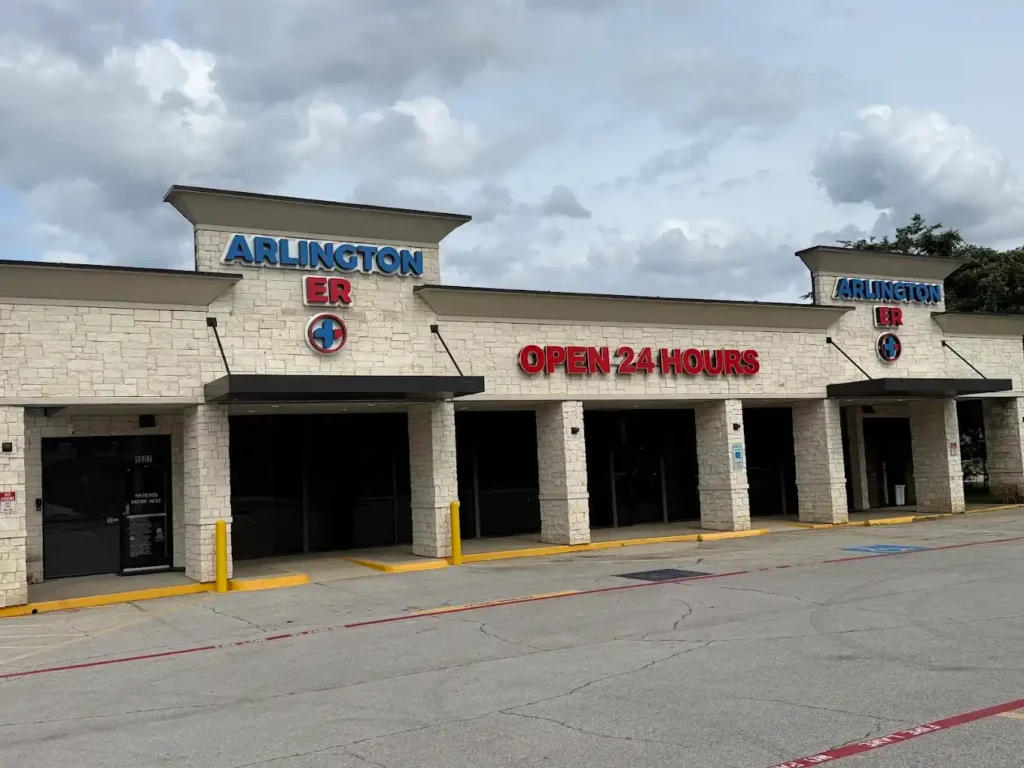
Arlington ER serves Arlington, Texas from 1607 S. Bowen Rd., on the west side of Bowen just south of Pioneer Parkway. Parking is directly outside the entrance, which matters when moving is painful and someone else has driven you.
We are minutes from central Arlington and the Parks Mall, and a short drive from Dalworthington Gardens, Kennedale, Grand Prairie, and Mansfield. From I-20, exit at Bowen Road and head north. From Highway 303 or Pioneer Parkway, turn south onto Bowen and we are on your right. Our Contact Us page has anything else you need.
If anyone has neck or back pain, call 911 rather than moving them. We are open every hour of every day, holidays included, with no appointment required.
Get checked the same day, even if nothing hurts yet. It protects your health, and it removes the gap that insurers use to argue your injuries came from something else. No payment due today if an attorney is handling your claim.
The same day wherever possible. It is better medically, because adrenaline hides injuries, and better legally, because a gap between the crash and being seen is the most common thing insurers dispute.
No. Come in and be treated. Bring the report number later if you have it, since it helps with a claim, but nothing about your care waits on paperwork.
Yes. A Letter of Protection lets you be treated with no payment at the time of service. Many auto policies also include medical coverage that applies regardless of fault, which is worth checking.
No. Come in and be assessed first. A Letter of Protection can be arranged afterward if you instruct an attorney, and delaying care to sort out paperwork helps nobody.
Most cases improve over two to six weeks, with the worst around day two or three. Some take months, and pain that is not improving after several weeks deserves a further look.
Yes, on your authorization. We handle these requests regularly and turn them around promptly, because a delayed record can hold up a claim for weeks.
Come in then. Delayed symptoms are normal after a collision and do not mean you imagined it. Being seen still matters, both for your recovery and for the record.
Yes, particularly for how the car seat performed and whether the belt sat correctly. Children often cannot describe what hurts, and seatbelt injuries in small bodies are easy to underestimate.
Medically reviewed by Rahman Mohammed, MD | Last Updated: August 10, 2026